
Auto rickshaws: history, CNG and the e-rickshaw boom
An auto rickshaw is a small three-wheeled motor vehicle for hire, the motorised descendant of the pulled and cycle rickshaw, known in much of the world as a tuk-tuk. It runs on petrol, CNG, LPG or electricity and is a staple of streets from Delhi to Bangkok[1].
What an auto rickshaw is
The auto rickshaw is a motorised version of the pulled or cycle rickshaw: usually three wheels, an engine or motor, and a fare-paying passenger seat[1]. The common layout puts the driver alone at the front, steering with handlebars like a scooter, with a bench for two or three passengers behind and a canvas or metal roof over everyone. Fuels include petrol, compressed natural gas (CNG), LPG and electricity[1].
| Fuel | Example |
|---|---|
| CNG | Delhi, after the 1998 Supreme Court order[4]; Mumbai, required since 2002[7] |
| LPG or petrol | Mumbai, where CNG is not available[7] |
| Electricity | About 2.4 million battery three-wheelers in India by 2022[1] |
Three wheels keep it short and narrow with a tight turning circle, at the cost of stability in fast corners. It fills the gap between a bus and a taxi: cheap enough for short daily trips, small enough to thread through traffic and lanes a car cannot use, and simple enough for owner-drivers to run and repair.
Origins: Japan and Italy
Three-wheeled motor vehicles came first as goods carriers. The 1931 Mazda-Go, a three-wheeled open truck, is often called the first ancestor of the auto rickshaw[1]. In the late 1930s Japan's Ministry of Posts and Telecommunications sent about 20,000 used three-wheelers to Southeast Asia, and knock-down kits of the Daihatsu Midget were later assembled in the region[1]. When Japan abolished its three-wheeler licence in 1965, Thailand began developing its own manufacturing and designs[1].
In Italy, Piaggio adapted its Vespa scooter into the Ape (Italian for bee, to the Vespa's wasp), a three-wheeled light commercial vehicle launched in 1948 and built ever since; Corradino D'Ascanio conceived the design, and it was first sold as the VespaCar or TriVespa[2]. Most Apes are now made in India, where they often work as auto rickshaws; Piaggio said in 2013 that production would move there entirely, and Pune in Maharashtra is one of its Indian assembly sites[2].
India and Bajaj
India is the auto rickshaw's biggest home, where it is usually just called an auto. Bajaj Auto, founded in 1945 as an importer and seller of two- and three-wheelers, began manufacturing three-wheelers in 1959 under a licence from the Government of India, the same year it took a Piaggio licence to build Vespa scooters[3]. It is now the world's largest maker of three-wheelers[3].
Cities also set their own rules. In Mumbai, autos are not allowed into the old island city: the southernmost points they can reach are Bandra Fire Station in the west and Sion in the central suburbs, beyond which metered taxis take over[7].
Why Delhi's autos run on gas
Delhi's switch to gas came from the courts. In the long-running air-pollution case M.C. Mehta v Union of India, the Supreme Court ordered on 28 July 1998, in a case brought by the environmental lawyer M.C. Mehta, that Delhi's entire city bus fleet be converted to run on CNG alone by 31 March 2001[5], and the order covered taxis and auto rickshaws too[4]. The same 1998 ruling ended Delhi's phat-phati, a shared ride built around an old Harley-Davidson engine[1].
The deadline was hard fought, and the court was still ruling on compliance in April 2001[5], but the result was a public transport fleet on gas. Mumbai followed: since 2002 all of its autos have been required to use CNG, though not all comply, and petrol or LPG is used where CNG is not available[7]. ThePrint calls the 1998 order one of India's most consequential pollution-control interventions[4].
The e-rickshaw boom
The newest wave is electric. Battery rickshaws spread informally first, carrying passengers and, as e-carts, goods; then India brought them into the Motor Vehicles Act: an ordinance on 15 December 2014, made law on 19 March 2015, defined e-rickshaws and e-carts as special-purpose battery vehicles with three wheels and power of up to 4,000 W, and eased licensing: drivers no longer had to hold a light motor vehicle licence for a year before getting a learner's licence for one[6]. By 2022 India had about 2.4 million battery-powered three-wheelers[1].
The same thing is happening across the region. In Bangladesh, reports counted about 4 million unregistered electric autos by 2025, up from around 200,000 in 2016[1]. Electric three-wheelers are quiet and produce no tailpipe smoke, which is much of their appeal in polluted cities.
Tuk-tuks around the world
Thailand made the name tuk-tuk famous. Bangkok's three-wheelers were called samlo in the 1960s; in 2017 about 20,000 tuk-tuks were registered as taxis in Thailand, about 9,000 of them in Bangkok, and an electric ride-hailing tuk-tuk service, MuvMi, launched there in 2018[1].
Elsewhere, three-wheelers arrived in Sri Lanka around 1979 and in Durban, South Africa, in the late 1980s, and they are common across Pakistan, Bangladesh and Nepal[1]. Cities keep reshaping them: Pune banned six-seater rickshaws on 10 January 2003, Dhaka banned two-stroke autos the same month, Sri Lanka banned two-stroke imports, and the Philippines' Land Transportation Office announced a ban on e-trikes on major Metro Manila roads from 2 January 2026[1].
Numbers, experiments and records
The scale is hard to picture. Mumbai's metropolitan region alone had about 246,458 metered autos in 2008[7]. Governments have tried to steer the fleet towards cleaner fuels: Pakistan planned to convert its petrol autos to CNG by 2015 and later offered easy bank loans for electric rickshaws, a two-year hydrogen three-wheeler trial began in New Delhi in 2009, and Mahindra showed the HyAlfa hydrogen auto in 2012[1].
Autos have even reached the United States, where Bajaj sold them from the mid-2000s until 2008, and the top of the world: on 16 September 2022 two teams drove an auto rickshaw up to Umling La, at 5,798 m, a record Guinness certified in October 2024[1].
Drive an auto rickshaw in Drive Your City
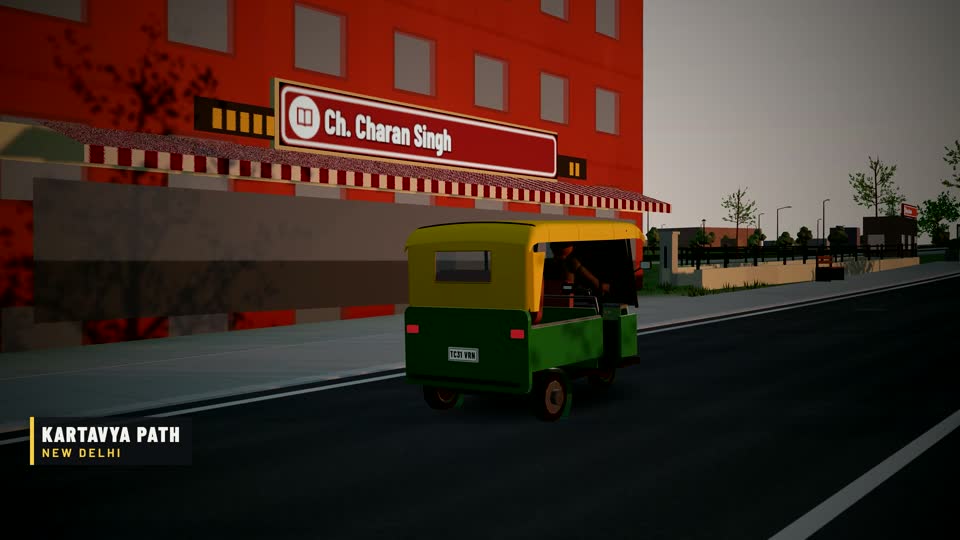
The Rikki 200 is the game's auto rickshaw, and it is the free starter vehicle for players in India. For a quieter ride, the Murmur is an electric e-rickshaw. Both are fictional designs with simulation values.
Take one through the real streets of Delhi, past India Gate, along the Mumbai seafront, or into Bangkok, the home of the tuk-tuk. Traffic includes buses and scooters, and the game runs in a phone browser in landscape with touch controls.
Questions
Who makes the most auto rickshaws?
Bajaj Auto of India, which began making three-wheelers in 1959 and is the world's largest three-wheeler manufacturer.
Why do auto rickshaws in Delhi run on CNG?
A Supreme Court order of 28 July 1998 in the M.C. Mehta air-pollution case required Delhi's buses, taxis and autos to switch to CNG, with a 2001 deadline.
Are auto rickshaws allowed in South Mumbai?
No. Autos cannot enter the old island city; Bandra in the west and Sion in the centre are as far south as they can go.
What is the difference between an auto rickshaw and an e-rickshaw?
An auto rickshaw has an engine running on petrol, CNG or LPG. An e-rickshaw runs on a battery and, in India, is legally limited to 4,000 W of power.
Sources
Facts on this page come from these sources, checked on 20 November 2026. Details about the game come from the game itself.
- Auto rickshaw, Wikipedia
- Piaggio Ape, Wikipedia
- Bajaj Auto, Wikipedia
- A 40-year legal battle for clean air, ThePrint
- M.C. Mehta vs Union of India, order of 4 April 2001, Supreme Court of India (via Indian Kanoon)
- The Motor Vehicles (Amendment) Ordinance, 2015, PRS Legislative Research
- Transport in Mumbai, Wikipedia