
Drag racing explained: from the Christmas tree to the finish line
Drag racing is a straight-line sprint between two cars from a standing start, usually over a quarter mile (402 m). A light tree starts the race, and the first car across the finish line wins, so a quick reaction at the start counts as much as a fast car[1].
The distances
The classic drag race is a quarter mile, 1,320 feet or 402 m. Some tracks run an eighth mile, 660 feet or 201 m[1]. The fastest classes, Top Fuel and Funny Car, race 1,000 feet. The NHRA shortened those classes in July 2008 as a safety measure after Scott Kalitta's fatal crash, leaving more room to slow down after the finish line[4].
Two numbers describe every run. Elapsed time (ET) runs from when the car leaves the start line to when it crosses the finish line. Trap speed is the average speed over the final 66 feet (20 m) before the line[1]. Top Fuel dragsters cover their distance in under 3.7 seconds with trap speeds over 330 mph[1].
The two numbers do not decide the race on their own. A car can post the higher trap speed and still lose, because the winner is whoever reaches the line first.
Staging and the Christmas tree
Between the lanes stands the starting light tower, called the Christmas tree. Each lane has two light beams at the start. Rolling forward to break the first, 7 inches behind the line, lights the pre-stage bulb. Creeping another 7 inches to break the second lights the stage bulb[2]. Once one driver is staged, the other has seven seconds to stage too[2].
On current NHRA trees the staging lights are blue, split into halves. Below them are three amber lights, a green and a red[1]. There are two ways to run them[2]:
- Pro tree: all three ambers flash together and green follows 0.4 seconds later.
- Full (Sportsman) tree: the ambers light one after another, 0.5 seconds apart, and green follows 0.5 seconds after the last.
Since 2009, the tree has been started automatically with a short random delay after both cars stage, so drivers can't anticipate the starter[2]. In 1962, NHRA field director Ed Eaton proposed a step-light countdown to Oliver Riley of the timing company Chrondek, and the tree debuted at the 1963 US Nationals in Indianapolis[2]. Who invented it is still disputed: W.H. David Jr., founder of a Louisiana timing association, claimed to have built one in the late 1950s, and the name may come from the small Christmas lights on his prototype[2].
Reaction time and the red light
Reaction time is the gap between the green light and the car leaving the beams[1]. Because ET only starts when the car moves, the driver who wins is the one whose reaction time plus ET is lower. A slower car can beat a faster one with a better start.
Leave before the green and the lane shows a red light, which normally means losing the race[1]. Good drivers react to the last amber rather than the green, timing it so the car moves just as the green comes on. Leave a fraction too early and the red light ends the run.
Fouls and handicap starts
The rules around a red light are more detailed than they look. In a heads-up race, leaving early stops the countdown and shows red, but leaving before the first amber even lights is a disqualification whatever the other driver does[2], so a red light is not always the end of the race on its own. If both drivers leave before the tree is activated, a steward decides using video[2]. In handicap racing on a standard tree, the slower car's lights start first, and the faster car's first amber is delayed by the difference between their dial-ins[2].
The burnout and the launch
Before each run, drivers spin the rear tyres in a burnout. It heats and softens the rubber and lays fresh rubber on the track, both of which improve traction[1]. Without it, even a powerful car can spin its tyres off the line and lose in the first few feet. The launch is then a balance. Too little power and the engine bogs down, too much and the tyres spin and smoke, and either loses time in the first few metres, where most of the race is won.
Top classes manage this with clutch and engine settings tuned for each track. Street-based cars rely on the driver's feet and on sticky tyres.
Classes and records
The NHRA, founded by Wally Parks in 1951, runs the main professional series in the US[1]. Its headline classes are[1]:
- Top Fuel: long, thin dragsters, the fastest class of all.
- Funny Car: similar power on a shorter wheelbase under a carbon-fibre body.
- Pro Stock: cars that look like production models, running the quarter mile in about 6.4 seconds.
- Pro Stock Motorcycle: purpose-built bikes that run under 6.8 seconds at over 195 mph.
The national records below were listed by NHRA in October 2026[3].
| Class | Quickest ET | Fastest speed |
|---|---|---|
| Top Fuel (1,000 ft) | 3.623 s, Brittany Force, 2019 | 346.95 mph, Shawn Langdon, 2026 |
| Funny Car (1,000 ft) | 3.793 s, Robert Hight, 2017 | 341.68 mph, Austin Prock, 2024 |
| Pro Stock (¼ mile) | 6.443 s, Greg Anderson, 2025 | 215.55 mph, Erica Enders, 2014 |
| Pro Stock Motorcycle (¼ mile) | 6.627 s, Gaige Herrera, 2023 | 205.04 mph, Matt Smith, 2021 |
Bracket racing
Much amateur drag racing is bracket racing, where any two cars can race fairly. Each driver predicts their ET, called the dial-in. The slower car gets a head start equal to the difference between the two dial-ins, so two perfect runs would tie[1]. Run quicker than your dial-in and you "break out" and usually lose[1]. Bracket racing rewards consistency and a sharp reaction time more than raw speed[1]. Because dial-ins even out the cars, a family car can race a much faster one on equal terms.
Drag racing in Drive Your City
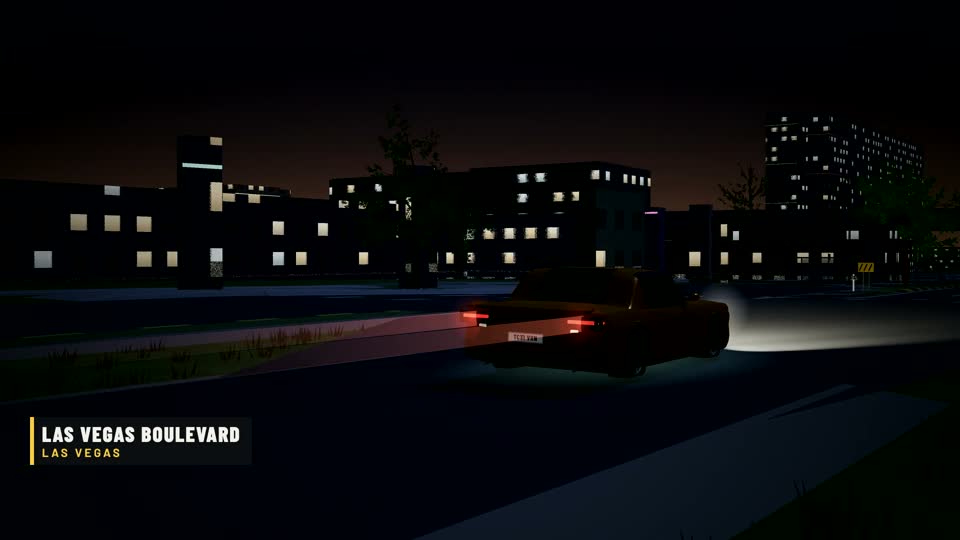
Drive Your City's Race menu has a Drag race type, short and straight, and a Speed Trap race that scores your total speed past cameras. The Tracks tab includes a straight on the D338 at Mulsanne for both. In the World Motorsport tab, the Drag discipline uses a light tree and a launch, with drag strips at Sakhir, Hockenheim, Charlotte, Las Vegas and Gateway.
Hold W on green and hold Shift for nitrous. The gearbox is automatic, so the launch and the nitrous are yours to judge. Try the Anvil 440, a rear-drive muscle car with V8 torque and four speeds, against the Halcyon X EV hypercar with four motors and 1,100 kW. Both are fictional, and their specs are simulation values.
Questions
How long is a drag race?
Most drag races are a quarter mile, 402 m. Some tracks run an eighth mile, 201 m. NHRA Top Fuel and Funny Car races have been 1,000 feet since 2008.
What is a good reaction time in drag racing?
Reaction time is measured from the green light to the car leaving the start beams, so a time close to zero is ideal. Anything below zero means the car left before green, which is a red light and normally loses the race.
What is the fastest drag racing class?
Top Fuel. In NHRA's October 2026 list, the Top Fuel records were 3.623 seconds over 1,000 feet and a top speed of 346.95 mph.
Sources
Facts on this page come from these sources, checked on 20 November 2026. Details about the game come from the game itself.
- Drag racing, Wikipedia
- Christmas tree (drag racing), Wikipedia
- NAPA Auto Parts NHRA Midwest Nationals Saturday preview (national records), NHRA
- NHRA shortens track after fatal crash, no longer 1/4 mile, Jalopnik
- Street racing, Wikipedia