
What is rally racing? Stages, pace notes and co-drivers
Rally racing sends cars one at a time over timed special stages on closed public roads and forest tracks, and the crew with the lowest total time wins. A co-driver reads pace notes aloud so the driver knows what is round each corner before it appears[1][4].
How rallying differs from circuit racing
In a circuit race cars start together and race wheel to wheel. In a rally they start at intervals and race the clock over a set route, on roads closed for the event[1]. Each stage is different, so drivers can't learn it lap by lap. They rely on notes made during a few slow reconnaissance runs.
The World Rally Championship, owned and governed by the FIA, began in 1973 with the Monte Carlo Rally as its first round[1]. A season usually has 13 rallies, each over three or four days, on gravel, tarmac, snow or ice, normally one surface per event[1].
How a WRC rally runs
- Recce: crews drive the stages slowly on Tuesday and Wednesday to write their pace notes[1].
- Shakedown: a test stage on Thursday to check the car's set-up[1].
- Special stages: usually 15 to 25 timed stages on closed roads, with a total competitive distance of under about 350 km[1].
- Liaison sections: the drives between stages on open roads, where crews must obey traffic laws and reach each time control within a set window or take a penalty[1].
- Service: a central service park where mechanics work on the cars, which are locked in parc fermé overnight[1].
- Power Stage: the final stage, where the five fastest crews earn five to one bonus points, a format used since 2011[1].
A crew that retires can often restart the next day, with a 10-minute penalty for each stage it missed plus the stage winner's time[1]. Points now come from a system introduced in 2024 rather than from the final overall order[1].
Timecards, points and the championship
Every crew carries a timecard, stamped by officials at each time control and stage, and an average rally day covers about 400 km of driving, stages and liaisons together[1]. The co-driver keeps the crew on schedule, because reaching a control outside its set window costs a penalty[1]. Co-drivers may only take the wheel in an emergency, under force majeure[1].
Manufacturers nominate up to three crews per rally, and their two fastest score for the team[1]. Since 2021 manufacturers have also scored Power Stage points from their top two nominated crews, and Power Stage times are recorded to a thousandth of a second[1]. That turns the last stage into a sprint, even for a driver with a big lead overall.
Pace notes and the co-driver
Pace notes are a shorthand description of the road: each bend, its direction and severity, the distance to the next feature, and hazards such as crests, jumps and potholes[4]. A world-class stage can fill many pages[4]. During recce, the co-driver helps write the notes, and later reads them aloud during the stage[1][4]. The notes are in the crew's own abbreviations, and units are left out when they are read[4].
Severity is usually a number, but there is no single standard. In the British club system, 1 is the gentlest bend and 5 is nearly a right angle, while other drivers number the other way, with 6 almost flat and 1 a hairpin, or call the gear for each corner[4]. The sharpest bends get words: "square" for 90 degrees and "hairpin" for about 180[4]. A typical call might be "left 4, 100, right 2 over crest", with cautions added where cutting the inside would hit a rock or a ditch[4].
Timing is the co-driver's craft: read too late and the driver can't prepare, read too early and they forget[4]. If the crew loses its place after a spin, the co-driver must find it again from the road around them[4]. A calibrated odometer the co-driver can control helps with the distance calls[4]. Some events supply an official set of notes and ban recce, so every crew uses the same notes[4].
Surfaces and cars
Gravel, tarmac and snow call for different set-ups and tyres, which is why most rallies stick to one surface[1]. Even a tarmac event can throw in ice, as Monte Carlo often does[2]. Gravel cars ride higher on softer suspension to soak up ruts and stones, while tarmac cars run low and stiff like circuit cars. On snow and ice, studded tyres bite through the surface.
The top class, Rally1, arrived in 2022. Its hybrid system proved costly and hard to repair mid-event, so it was dropped for the 2025 season[1].
Monte Carlo and the Col de Turini
The Monte Carlo Rally was founded by Prince Albert I of Monaco in 1911[2]. For decades crews set off from cities across Europe and converged on Monaco, a format that ended in 1997[2]. It opened the World Rally Championship from 1973 to 2008[2].
Its hardest test is the weather. A single stage can mix dry tarmac, wet tarmac, snow and ice, and tyres that grip on ice are poor on dry asphalt, so tyre choice is a gamble[2]. The most famous stage crosses the Col de Turini, a 1,607 m pass in the mountains above Nice[3]. The 31 km stage runs between La Bollène-Vésubie and Sospel[3]. When it ran at night in front of thousands of fans, it was called the "Night of the Long Knives", after the headlight beams cutting through the dark[2][3]. The pass is famous in cycling too: the Tour de France has crossed it, including in 1948 and 2024[3].
Rallycross and rally raid
Two related disciplines share the name. Rallycross puts several cars on a short mixed-surface circuit at once, and each car must take a longer joker lap once per race[5]. Its races are short multi-car sprints, closer to circuit racing than to stage rallying. Rally raid goes the other way: days of cross-country stages across deserts, navigated by roadbook rather than pace notes. The Dakar Rally is the best known.
Rally in Drive Your City
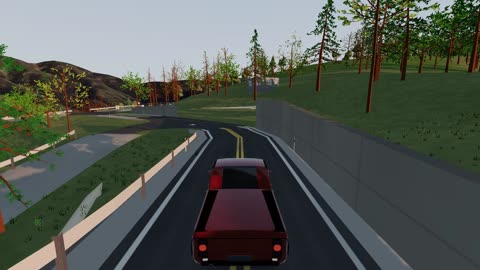
The Rally discipline in Drive Your City's World Motorsport tab runs timed stages with pace notes called out as you drive. Stages include the Col de Turini at night, Snake Pass and a gravel stage in the Nürburg forest. The Off-Road discipline adds rallycross loops with jumps at Montalegre and Hell in Norway.
Take the Gravel Ghost rally car, with its turbo four and all-wheel drive, and set stability assists to Sport or Off so it slides. The game has no snow or ice, but B brings rain, storms or fog, and rain makes the road slippery. Use Space for the handbrake on hairpins.
Questions
What is the difference between rally and rallycross?
A rally sends cars one at a time over long timed stages on closed roads, and the fastest total time wins. Rallycross races several cars together on a short mixed-surface circuit, with a longer joker lap each car must take once.
What does a rally co-driver do?
The co-driver helps write the pace notes during reconnaissance, reads them aloud during each stage so the driver knows what is coming, and keeps the crew on time at the time controls between stages.
Why is the Monte Carlo Rally so hard?
Its mountain stages can mix dry tarmac, wet roads, snow and ice within a few kilometres, so no tyre suits every section. Crews have to guess what the road will be like when they get there.
Sources
Facts on this page come from these sources, checked on 20 November 2026. Details about the game come from the game itself.
- World Rally Championship, Wikipedia
- Monte Carlo Rally, Wikipedia
- Col de Turini, Wikipedia
- Pacenotes, Wikipedia
- Glossary of motorsport terms, Wikipedia