
Countries that drive on the left: the full list and how to adapt
About 75 countries and territories drive on the left, home to roughly a third of the world's people. They include the United Kingdom, Ireland, Malta and Cyprus in Europe; India, Japan, Indonesia, Thailand and Pakistan in Asia; Australia and New Zealand; South Africa, Kenya and much of southern and eastern Africa; and several Caribbean nations.
How many countries drive on the left
The count depends on what you count. Including territories, 75 countries and territories use left-hand traffic and 165 use right-hand traffic. Counting only the 195 countries recognised by the UN, 54 drive on the left and 141 on the right[1].
The split is uneven. Left-hand traffic covers about a sixth of the world's land area and about a quarter of its roads, but about a third of its population, because it includes some of the most populous countries on Earth: India, Indonesia, Pakistan, Bangladesh and Japan[1].
The list by region
| Region | Countries and territories |
|---|---|
| Europe | United Kingdom, Ireland, Malta, Cyprus, the Isle of Man, Guernsey and Jersey |
| Asia | Bangladesh, Bhutan, Brunei, Hong Kong, India, Indonesia, Japan, Macau, Malaysia, Maldives, Nepal, Pakistan, Singapore, Sri Lanka, Thailand and Timor-Leste |
| Africa | Botswana, Eswatini, Kenya, Lesotho, Malawi, Mauritius, Mozambique, Namibia, Seychelles, South Africa, Tanzania, Uganda, Zambia and Zimbabwe |
| Americas | Guyana and Suriname; the Bahamas, Barbados, Dominica, Grenada, Jamaica, Saint Kitts and Nevis, Saint Lucia, Saint Vincent and the Grenadines, and Trinidad and Tobago; territories including Bermuda, the Cayman Islands and the British and US Virgin Islands |
| Oceania | Australia, New Zealand and Samoa |
The lists follow the country-by-country summary of left- and right-hand traffic on Wikipedia, which also covers smaller territories[1].
Why some countries keep left
The biggest single reason is the British Empire. Britain introduced left-hand traffic across much of its territory in Africa and Asia, including British India, Malaya, Borneo and Hong Kong, and many former colonies kept it[1].
Japan is the main exception to that pattern. Keeping left there goes back to the Edo period (1603 to 1868); it was officially acknowledged in 1872, when Japan's first railway was built with British technical help, and became law in 1924[1]. A popular story says Napoleon moved continental Europe to the right, but historians have found no documents to support it[1].
Where people drive on the left, cars are usually right-hand drive, with the steering wheel on the right, although most countries do not regulate the wheel's position. Henry Ford standardised the Model T as left-hand drive in 1908[1].
Countries that switched sides
Changing sides is rare and expensive, but it has happened. Sweden moved from left to right on Sunday 3 September 1967 at 5 am, a day known as Dagen H, even though a referendum in 1955 had rejected the change. Accidents fell sharply at first, then returned close to their earlier level[1]. The switch shows how much a whole country has to change at once: signs, junction layouts, bus doors and every driver's habits.
The most recent switch went the other way. Samoa, a former German colony that had driven on the right for over a century, changed to the left on 7 September 2009, the first territory to change sides in almost 30 years. The aim was cheaper car imports from Australia, New Zealand and Japan[1].
Where the side changes at a border
A few land borders join left- and right-hand traffic. Thailand, which drives on the left, borders Cambodia, Laos and Myanmar, which drive on the right; most crossings use traffic lights to swap traffic over, and some use interchanges[1]. Hong Kong has six road crossings with mainland China; the busiest, Lok Ma Chau, averaged 31,100 vehicle trips a day in 2006. In the Americas, the Takutu River Bridge between Guyana and Brazil is the only place where traffic changes sides[1].
Before you drive on the other side
Most of the work happens before you collect the car. If you are moving abroad rather than visiting, GOV.UK advises exchanging your UK licence or applying for a local one instead of an IDP[2]. For visiting UK drivers, GOV.UK says you might need an international driving permit (IDP), possibly one for each country you visit; they cost £5.50 and are issued at some PayPoint shops[2]. It also says to check your insurance covers every country on the route, to follow local speed limits and drink-driving laws, and to carry any equipment the country requires, such as a reflective jacket or warning triangle[2].
New Zealand's government travel advice adds the basics for any country: find out whether you keep left or right and who gives way, and check that your travel insurance covers driving. Riding a scooter without the right licence can void the insurance after a crash[3]. It also suggests learning local habits for merging, using the horn and flashing headlights, never leaving your passport with a hire company, and keeping enough money to cover the excess if the car is damaged[3].
If you take your own car, GOV.UK lists the documents to bring: the V5C log book and insurance certificate, or a VE103 certificate for a vehicle hired or leased in the UK. You may also need headlight converter stickers so the beams do not dazzle oncoming drivers on the other side of the road, and a UK sticker[2]. Some European cities require emission stickers that can take weeks to arrive[2].
- Take the first drive on quiet roads, not straight out of an airport into a city at rush hour.
- Be most careful when pulling away from a car park or fuel station and after turning, when habit takes over.
- At junctions and crossings, look both ways twice: traffic arrives from the side you do not expect.
- Learn the local rules for junctions and roundabouts before you need them.
Explore left-hand-traffic cities in Drive Your City
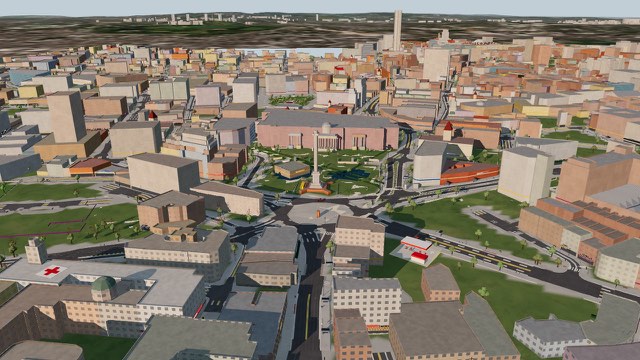
You can drive the real street layouts of many left-hand-traffic cities in the browser, which is a handy way to get to know a city's roads before a trip: try London, Tokyo, Mumbai, Delhi, Sydney, Cape Town, Singapore or Bangkok.
Search any address, or press M for the map with search and turn-by-turn navigation to follow a route you will drive for real (map and navigation). It shows you the layout of a place, not its traffic law, so learn the rules from the country's road authority.
Questions
How many countries drive on the left?
About 75 countries and territories, or 54 of the 195 UN-recognised countries. Together they hold about a third of the world's population.
Which European countries drive on the left?
The United Kingdom, Ireland, Malta and Cyprus, plus the Isle of Man, Guernsey and Jersey.
Why does Japan drive on the left?
Keeping left dates from the Edo period. It was officially acknowledged in 1872 when Japan's first railway was built with British help, and it became law in 1924.
Which was the last country to switch sides?
Samoa, which moved from the right to the left on 7 September 2009, largely to allow cheaper car imports from Australia, New Zealand and Japan.
Do I need an international driving permit?
It depends on the country and your licence. UK drivers can check GOV.UK, which says you might need one for each country you visit.
Sources
Facts on this page come from these sources, checked on 20 November 2026. Details about the game come from the game itself.
- Left- and right-hand traffic, Wikipedia
- Driving abroad, GOV.UK
- Driving overseas, SafeTravel (New Zealand Government)