
The Autobahn speed limit: where it is unlimited and the rules that apply
Much of Germany's Autobahn has no general speed limit for cars, but it is not a free-for-all. An advisory speed of 130 km/h applies wherever no limit is signed, about a quarter of the network has permanent limits, lorries and cars towing trailers are capped at 80 km/h, and strict lane rules apply everywhere.
Is there a speed limit on the Autobahn?
For cars, often not. Where no limit is posted, Germany recommends 130 km/h, the Richtgeschwindigkeit, but does not enforce it[1][2]. Sections with signed limits are common, either permanent or shown on variable overhead signs, and those limits are enforced like any other.
Heavier vehicles always have limits. Under section 18 of the German road traffic regulations (StVO), lorries over 3.5 tonnes, cars and other vehicles towing trailers and most buses are limited to 80 km/h on the Autobahn, and buses that meet extra conditions to 100 km/h[4].
The 130 km/h advisory speed
The advisory speed comes from the Autobahn-Richtgeschwindigkeits-Verordnung. According to ADAC, the German motoring club, it applies to motor vehicles up to 3.5 tonnes, on the Autobahn and on other roads outside towns with separated carriageways or at least two marked lanes each way, and only in the best road, weather, visibility and traffic conditions. Once a limit is signed, the limit replaces it[2].
Driving faster than 130 km/h is not an offence in itself: there is no fine and no penalty points. The cost comes after a crash. If a crash would have been avoided at the advisory speed, a driver going faster can be held partly liable, usually for at least 20 per cent, even when someone else caused it[2]. In one case ADAC cites, a driver at 200 km/h was held 30 per cent liable for a lane-change collision that was mostly the other driver's fault; in another, a driver at 200 km/h on an Autobahn-like federal road was held 20 per cent liable because experts said the crash would not have happened at 130 km/h[2].
No sign is needed for the advisory speed, since it applies by default. Visitors see it at the border, where a sign reminds drivers entering Germany of the recommended 130 km/h[2].
How much of the Autobahn is unrestricted
ADAC, using 2025 data from the Federal Highway Research Institute (BASt), measures the network by carriageway length, counting each direction separately[3]:
| Limit | Length | Share |
|---|---|---|
| No permanent limit | 19,301 km | 73.1 % |
| 130 km/h | 1,353 km | 5.1 % |
| 120 km/h | 3,088 km | 11.7 % |
| 100 km/h | 1,780 km | 6.7 % |
| 80 km/h | 767 km | 2.9 % |
| 60 km/h or lower | 132 km | 0.5 % |
On top of the permanent limits, just under ten per cent of the network has variable signs that can set a limit for traffic or weather[3], so an unrestricted stretch on the map is not always unrestricted on the day. As a route network, the Autobahn is about 13,200 km long[1].
The unrestricted share has not shrunk much over time. A 2017 report by BASt found that in 2015, 70.4 per cent of the network had only the advisory speed, compared with 69.2 per cent in 2006 and 65.5 per cent in 2008[1]. Traffic matters as much as signs: open, unlimited driving is most often possible on Sundays, when lorry drivers must rest by law[1].
Who may use it, and what is banned
Section 18 of the StVO sets the basic rules[4]:
- Only motor vehicles built to go faster than 60 km/h may use the Autobahn, so slow vehicles such as mopeds are excluded.
- Turning round and reversing are banned.
- Stopping is banned, including on the hard shoulder.
- Pedestrians may not enter the Autobahn.
- Vehicles and their loads may be no more than 4 metres high and 2.55 metres wide.
The same section applies most of these rules to Kraftfahrstraßen, Germany's expressway-style roads. Where an Autobahn passes through a built-up area, speeds above the usual 50 km/h town limit are allowed[4].
Keep right, and never pass on the right
The left lane is for overtaking, and drivers are expected to move back to the right when it is free[1]. Overtaking on the right is banned, with narrow exceptions. In queues where all lanes are slow, the right lane may move faster than the left. Where the left lane is stopped or moving at no more than 60 km/h, you may pass on the right with extreme care and at most 20 km/h faster, so no more than 80 km/h[5]. Passing on the right outside towns otherwise costs a fine of 100 euros and a penalty point[5].
The practical effect is that fast traffic can arrive in the left lane very quickly. Check the mirrors early and twice before pulling out, and judge the closing speed of what is behind you, not just the gap.
The Rettungsgasse: the emergency corridor
When traffic slows to walking pace or stops, German law requires drivers to open an emergency corridor straight away, not once the queue has formed. Drivers in the far-left lane move left and those in every other lane move right, keeping a clear channel for ambulances and police; the hard shoulder stays clear for breakdown vehicles, and motorcyclists are not exempt[6]. A German appeal court in Oldenburg has ruled that the corridor must be formed immediately, with no waiting period[6].
Failing to form one costs 200 to 280 euros, two points and a one-month driving ban; driving through the corridor yourself costs 240 to 320 euros, with the same points and ban[6].
A short history
The first public road of its kind, between Cologne and Bonn, opened on 6 August 1932, though it was not yet called an Autobahn. Berlin's AVUS is regarded as the first car-only road and the forerunner of the network[1].
High-speed driving in Drive Your City
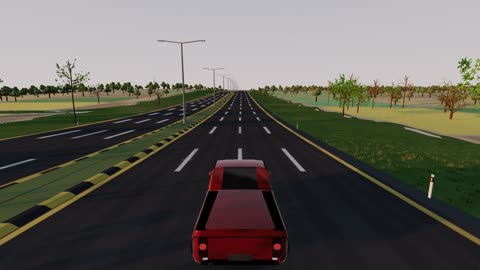
Drive the Autobahn A9, rebuilt from open map data, or head out of Berlin. For flat-out runs, the Race menu has straight tracks on the Afsluitdijk and the Mulsanne straight with Speed Trap and Drag races; hold Shift for nitrous. Try it in the sports coupe or the four-motor EV hypercar.
Police are optional and off by default in free roam (police chases). Rain makes the road slippery in the game too: press B to change the weather and feel how much longer it takes to stop.
Questions
Is there a speed limit on the Autobahn?
Not everywhere. About 73 per cent of carriageway length has no permanent limit for cars, but an advisory 130 km/h applies, many sections have signed limits, and lorries and vehicles with trailers are limited to 80 km/h.
What is the recommended speed on the Autobahn?
130 km/h, the Richtgeschwindigkeit. Exceeding it is not fined, but after a crash a faster driver can be held partly liable.
Can you overtake on the right on the Autobahn?
No, except in slow queues or when the left lane is stopped or doing 60 km/h or less, and then only up to 20 km/h faster. Otherwise it costs 100 euros and a point.
What is a Rettungsgasse?
An emergency corridor. When traffic slows to walking pace, the far-left lane moves left and all other lanes move right so emergency vehicles can get through.
Is there a minimum speed on the Autobahn?
There is no posted minimum for cars, but only vehicles built to exceed 60 km/h may use it.
Sources
Facts on this page come from these sources, checked on 20 November 2026. Details about the game come from the game itself.
- Autobahn, Wikipedia
- Richtgeschwindigkeit: Wann sie gilt und was sie bedeutet, ADAC
- Tempolimit auf Autobahnen: Die Fakten, ADAC
- Straßenverkehrs-Ordnung (StVO) § 18 Autobahnen und Kraftfahrstraßen, Federal Ministry of Justice (gesetze-im-internet.de)
- Rechts überholen: Wann ist es auf Autobahn und Co. erlaubt?, ADAC
- Rettungsgasse, ADAC