
Off-road driving tips: preparation, technique and where it is legal
The core off-road rules are: never go alone, stay on routes where vehicles are allowed, check the vehicle, tyres and recovery gear before you leave, go over obstacles slowly rather than around them, lower tyre pressures only for sand and restore them for the road, and leave a trip plan with someone who will act if you are late.
Start with the vehicle and tyres
Off-road vehicles are usually modified for the job, with suspension lifts, off-road tyres, skid plates to protect the underside and, for water, snorkels[6]. Tyres matter most. For rough desert tracks, the US National Park Service recommends proper off-road tyres rather than highway tyres, which puncture often on rock, plus at least one inflated spare and preferably two, a puncture repair kit and a 12-volt compressor[2].
Check fluids, tyres and the spare before every trip, and know where the recovery points on your vehicle are. A tow from a remote track is expensive, and ordinary breakdown cover often does not reach dirt roads[2].
Never go alone
A second vehicle turns a stuck car into a short delay instead of an emergency. Experienced desert drivers in the UAE travel as a convoy at the pace of the slowest car, each driver watching the vehicle behind, with 20 to 40 metres between cars depending on the ground[5]. If the last car gets stuck, its driver turns on the headlights so the others know to come back[5].
Whoever you go with, someone at home should know your plan. The park service advises leaving a trip plan with a reliable person who will follow up after your return time, and a dated note of the plan in the vehicle[2]. Do not rely on a phone: in many remote areas there is no signal at all[2], and mapping apps can lead you onto the wrong tracks[3]. Carry a paper map, and leave the return plan with a friend or relative[3].
In organised desert trips, it is customary for drivers to meet up with other vehicles and a group leader before setting out, then follow the leader in single file so nobody gets lost[6]. Joining a club or a guided trip is the easiest way to learn the basics with people who can recover you.
Where you can legally drive
Off-road does not mean anywhere. The Tread Lightly principles, used widely in the United States, start with travelling only on designated roads, trails and areas, respecting private property and leaving gates as you found them[1]. They also ask drivers to collect maps and rules from the land agency before going, to yield to people passing or heading uphill, to leave a place in better shape than they found it, and to avoid spreading invasive species on tyres and underbodies[1].
The law can be strict. In Death Valley National Park, driving off roads is prohibited and damaging a road surface is banned[2]. In the US, mud driving is illegal on public land because of the damage it causes, and in many places an off-road park may be the only legal place to drive off the road[6]. Some routes also need permission: Australia's Canning Stock Route crosses native title lands and needs permits before travel[8]. Rules differ by country, state and landowner, so check them for the exact route.
Reading the ground
Most off-road trouble starts with a poor line rather than a lack of power. The Tread Lightly guidance gives the basics[1]:
- Go over obstacles, not around them, so tracks do not widen.
- Cross streams only at marked fords.
- Avoid wet, muddy trails where you can, and keep off meadows, lake shores, wetlands and streambeds, where wet soil is easily damaged.
When you cannot see the ground, get out and look, or use a spotter: someone on foot who can see what the driver cannot and guide the car through[6]. Choose where you stop with care, too; on sand, most vehicles that get stuck do so because the driver stopped in the wrong place[5]. And if a track is closed or looks beyond you or the car, turn back. The park service puts it simply: if in doubt, do not drive[2].
Sand, mud and tyre pressure
Lowering tyre pressure widens the tyre's footprint and spreads the vehicle's weight, which is why it helps on sand[6]. Queensland motoring club RACQ suggests about 15 to 18 psi for general sand and 12 to 15 psi for soft sand, within the vehicle maker's minimum, with four-wheel drive engaged before you reach the sand[4]. Keep a steady momentum, use the firmer sand and existing ruts, and on beaches drive near the shoreline within two hours either side of low tide, when the sand is firmest[4].
Soft tyres are only for soft ground. Restore road pressures before you return to tarmac, which is why a compressor belongs in the kit[4]. Specialist beadlock wheels let competition vehicles run even lower pressures without the tyre leaving the rim[6].
Recovery gear and getting unstuck
RACQ's list of recovery essentials for any off-road 4WD is a shovel, recovery boards, a snatch strap and a suitable jack[4]. Desert convoys add heavy-duty tow ropes, a tyre compressor, a wooden base board so the jack does not sink, a good spare and a first aid kit[5]. High-lift jacks and winches are common on more serious vehicles[6].
Recovery is where people get hurt, because straps and ropes store energy. Learn to use the gear on a course before you need it, attach only to rated recovery points, and keep everyone well clear of a strap under tension.
Famous routes to work up to
The Rubicon Trail in California's Sierra Nevada, west of Lake Tahoe, is a 22-mile route of which about 12 miles is rough trail, managed by El Dorado County and the Eldorado National Forest. Its obstacles have names, such as Walker Hill, Cadillac Hill and the Little Sluice, which was made somewhat easier after changes in 2012[7]. The Canning Stock Route in Western Australia runs 1,850 km from Halls Creek to Wiluna across three deserts, is not maintained, needs substantial planning and is only practical in the cool season[8].
Off-road in Drive Your City
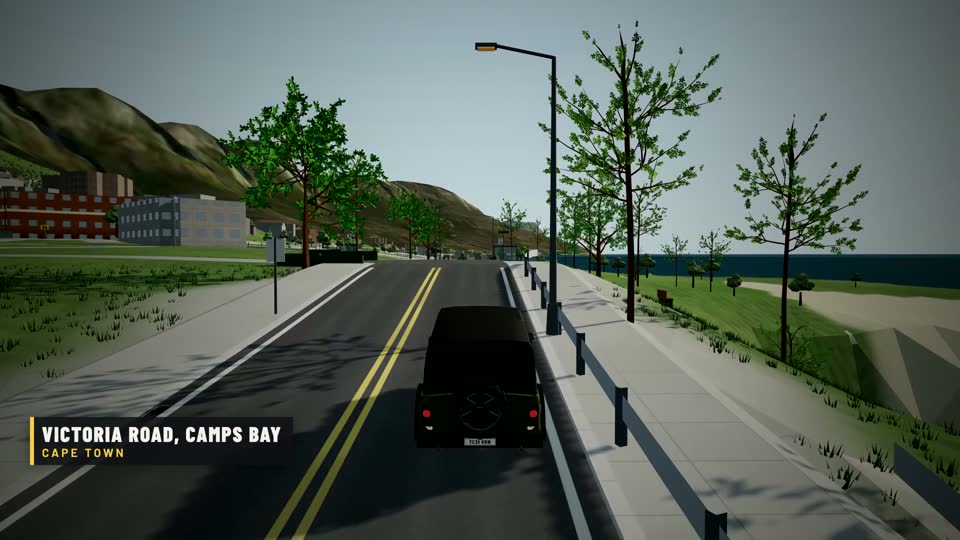
The game has grass, dirt and sand surfaces and real hills from open elevation data, so you can leave the road almost anywhere (terrain and off-road). The 4x4 off-roader has mud tyres, long suspension travel and low range; the pickup has part-time all-wheel drive and the SUV full-time all-wheel drive. For something less sensible, try the monster truck.
In World Motorsport, Off-Road events are rallycross loops with jumps and mixed grip at Montalegre and Hell in Norway, Rally includes a gravel stage in the Nürburg forest, and Desert Raid navigates by heading and distance with no road. Rain makes surfaces slippery, and R puts you back on the road if you get stuck, which real recovery gear cannot.
Questions
Is it legal to drive off-road anywhere?
No. In most places vehicles must stay on designated roads, trails or off-road areas, and driving onto private land needs the owner's permission. National parks often ban driving off roads entirely, so check the rules for the exact route.
What tyre pressure should I run off-road?
It depends on the ground and the vehicle. For sand, RACQ suggests about 15 to 18 psi, or 12 to 15 psi for soft sand, within the maker's minimum. Always restore road pressures before driving on tarmac.
What recovery gear should I carry?
At minimum a shovel, recovery boards, a snatch strap, a suitable jack with a base board, a compressor and a good spare, plus a first aid kit.
Should you go off-roading alone?
It is much safer not to. Travel with at least one other vehicle and leave a trip plan with someone who will raise the alarm if you are late.
Sources
Facts on this page come from these sources, checked on 20 November 2026. Details about the game come from the game itself.
- T.R.E.A.D. Principles, Tread Lightly!
- Backcountry Roads: Death Valley National Park, US National Park Service
- Desert Driving Safety, US National Park Service (Mojave National Preserve)
- Tips for driving on the beach, RACQ
- KT for good: Never drive alone in the desert, Khaleej Times
- Off-roading, Wikipedia
- Rubicon Trail, Wikipedia
- Canning Stock Route, Wikipedia