
FWD vs RWD vs AWD vs 4WD: how each drivetrain behaves
Front-wheel drive is cheap, roomy and tends to understeer; rear-wheel drive balances the car and can oversteer under power; all-wheel drive shares the work for traction; four-wheel drive adds driver-selected modes and low-range gears for rough ground[1][2][3].
The four layouts at a glance
| Layout | Driven wheels | Typical cars | Tendency at the limit |
|---|---|---|---|
| FWD | Front | Most everyday cars | Understeer: the nose runs wide |
| RWD | Rear | Sports cars, many luxury saloons, most pickups | Oversteer under power: the tail steps out |
| AWD | All four, managed automatically | Crossovers, fast saloons, rally cars | Depends on the torque split |
| 4WD | All four, selected by the driver, often with low range | Off-roaders and work trucks | Built for traction, not cornering |
Typical cars follow Mazda's guide to drivetrains[2]; handling tendencies follow Continental Tyres[3]. These are tendencies, not rules: suspension, tyres and electronics can make any layout neutral.
Front-wheel drive
Front-engine, front-wheel drive has been the most common layout for cars since the late 20th century[1]. The 1959 Mini made it mainstream: it was the first production front-drive car with a water-cooled four-cylinder engine mounted sideways, which left about 80 % of the floor for people and luggage[4]. Fiat's 128 then put the gearbox on the end of the engine rather than under it, and that arrangement became close to an industry standard[4].
The benefits are packaging and cost: no driveshaft to the back, a flat floor, and the engine's weight sitting over the driven wheels. The drawbacks show at the limit. The front tyres have to steer, brake and put the power down at once, so front-drive cars are more prone to understeer, where the car pushes wide of the line you steered[3]. Under hard acceleration, power can tug at the steering wheel, an effect called torque steer[4].
Rear-wheel drive
Front-engine, rear-wheel drive was the traditional layout for most of the 20th century and is still the most common rear-drive layout[1]. It splits the jobs: the front tyres steer, the rear tyres drive. That spreads weight more evenly and keeps drive forces out of the steering, which is why it remains the choice for sports cars, many luxury saloons and most pickups[2].
The catch is that a rear-drive car with enough power can spin its rear wheels and start oversteer at any moment[5], and rear-drive cars are generally more prone to oversteer than front-drive ones[3]. In slippery conditions that once made them harder to handle, though modern stability control largely cancels the difference[6]. Packaging suffers too: the driveshaft needs a tunnel through the cabin[6].
All-wheel drive
All-wheel drive can send power to every wheel and works automatically, with no input from the driver[2]. Mazda splits it into two kinds[2]:
- Part-time AWD normally drives one axle and brings in the other when sensors detect slip. It saves fuel and is the common type in crossovers.
- Full-time AWD drives both axles all the time, with a centre differential letting them turn at different speeds. It is becoming less common.
AWD is favoured where grip varies, such as rally stages and off-road tracks[1], and it has spread into fast road cars: Porsche added it to the 911 in 1989[1]. The handling depends on how the torque is split. A front-biased system feels like a grippy front-drive car; a rear-biased one keeps some rear-drive character. AWD helps a car pull away and accelerate on a loose surface, but every car already brakes on all four wheels, so it does nothing for stopping distances.
Four-wheel drive: part-time, full-time and low range
In a four-wheel-drive system both axles are driven and turn at the same speed, which suits off-road ground and deep snow because the car keeps moving when one or two wheels lose grip[2].
- Part-time 4WD is selected through a transfer case, usually with 2-high, 4-high and 4-low settings. Locked together, the axles cannot turn at different speeds in a bend, so it should not be used on dry tarmac unless the system has an Auto mode[2].
- Full-time 4WD stays engaged and cannot be switched to two-wheel drive; a centre differential lets it run on tarmac[2].
- Low range is a set of reduction gears that multiplies torque for steep climbs, mud, sand and heavy towing. The vehicle usually has to stop before shifting into it[2].
- Locking differentials force both wheels on an axle to turn together so a wheel in the air cannot take all the drive; they are mostly found on 4WD vehicles and often work only in low range[2].
SUVs and off-roaders covers the rest of the off-road kit.
Where the engine sits
The driven wheels are only half of a car's layout; the engine's position matters as much. Weight distribution has the largest effect on a car's steady cornering balance: moving the centre of mass forward tends to increase understeer, and moving it back tends to reduce it[5].
- Front engine: the default for most cars, front or rear drive.
- Mid engine: just ahead of the rear axle, chosen for its low moment of inertia and favourable weight distribution, and found mainly in sports and racing cars[1]. The car rotates eagerly into corners.
- Rear engine: rare in petrol cars but common in electric cars and buses; the Porsche 911 has used it continuously since 1963[1].
Drivetrains in racing
Race cars show each layout at its most extreme. A NASCAR Cup car is front-engined and rear-wheel drive, with a 5.86-litre V8 and a five-speed sequential gearbox[7]. A World Rally Championship Rally1 car is four-wheel drive, because a rally stage can change from tarmac to gravel within a few hundred metres[8]. Formula 1 cars are mid-engined and drive the rear wheels.
The pattern matches the road. Rear drive suits high power on a grippy surface where the driver wants to steer the car with the throttle; four-wheel drive suits loose and changing surfaces.
Which one to choose
For everyday driving, the layout matters less than the tyres and the electronics. A front-drive car on good tyres with stability control is predictable and economical. Rear drive is worth having if you enjoy driving and the car has enough power to use it. AWD earns its weight where roads are often wet, loose or hilly, or where you tow. Real 4WD with low range only makes sense if you regularly leave the tarmac.
Every drivetrain in Drive Your City
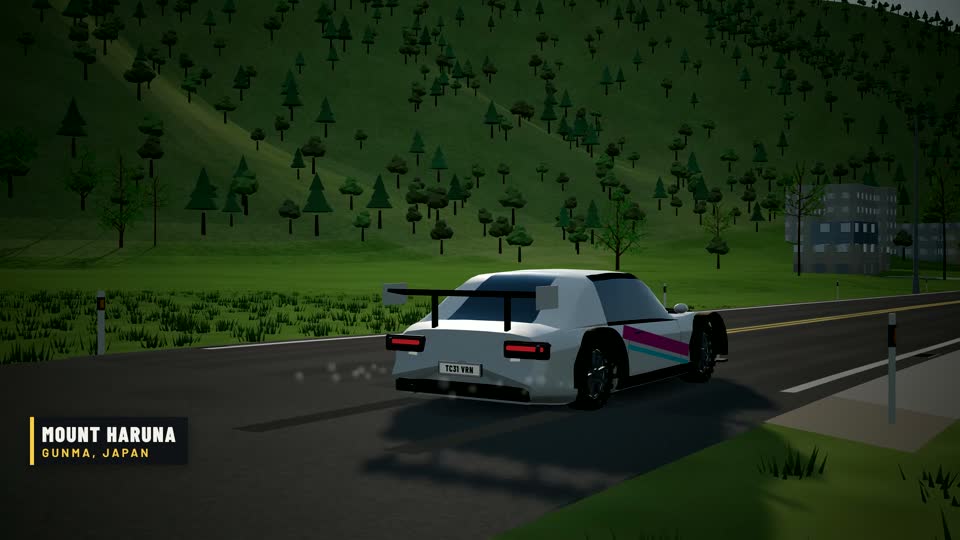
Each vehicle in the game has a real layout, so the differences above show up when you drive. The Pico, Lumo and Sola are front-wheel drive and push wide if you add throttle mid-corner. The Vesper GT, Anvil 440, Kaze RS and Regent are rear-wheel drive and can be steered with the throttle. The Bastion is full-time AWD with 50 % of the drive at the front, the Trailhand is part-time AWD, the Gravel Ghost is AWD, the Sentinel is a rear-biased 4x4 and the Flux is AWD with 40 % at the front.
To feel the difference, set Stability assists to Sport or Off, take the same corner in the Pico and the Kaze RS, and tap Space for the handbrake. Understeer vs oversteer explains what you are feeling.
Questions
Is AWD the same as 4WD?
Not quite. AWD runs automatically and is designed for roads, while 4WD is usually selected by the driver and often adds low-range gears for off-road use.
Which is better, FWD, RWD or AWD?
It depends on the job. FWD is roomy and cheap to run, RWD gives balanced handling, and AWD gives the most traction when pulling away on loose or wet surfaces.
Why should part-time 4WD not be used on dry roads?
It locks the front and rear axles together, so they cannot turn at different speeds in a bend. On high-grip tarmac that strains the drivetrain.
What does low range do?
It adds reduction gears that multiply torque, so a 4x4 can crawl up steep slopes or through mud and sand slowly and under control.
Sources
Facts on this page come from these sources, checked on 20 November 2026. Details about the game come from the game itself.
- Car layout, Wikipedia
- AWD vs. 4WD vs. 2WD systems, Mazda USA
- Understeer vs oversteer, Continental Tyres
- Front-wheel drive, Wikipedia
- Understeer and oversteer, Wikipedia
- Rear-wheel drive, Wikipedia
- Next Gen car, Wikipedia
- Group Rally1, Wikipedia