
What is a sports car? Seats, weight and layout
A sports car is a car built mainly for driving pleasure: handling, acceleration and feel come before space. It usually has two seats or a cramped 2+2, low weight, and traditionally rear-wheel drive, but there is no strict definition[1].
The definition, such as it is
Definitions of the sports car tie it to dynamic performance (handling, acceleration, top speed, the pleasure of driving) without setting a minimum for any of them[1]. That is why a small Triumph Spitfire and a Ferrari 488 Pista can both be called sports cars despite a huge gap in pace[1]. Other definitions say performance must matter more than carrying capacity, and stricter ones demand two seats or a 2+2[1].
The traditional sports car was an open two-seat roadster. Today most are two-seaters or 2+2s, whose rear seats suit children or short trips; a car with roomy rear seats is usually called a sports saloon instead, and the three-seat McLaren F1 is a notable exception[1]. Since the 1970s the term has also covered fixed-roof cars that would once have been called grand tourers[1].
Light weight first
The purest sports cars get their performance from shedding mass rather than adding power. Wikipedia points to 1960s roadsters such as the MG B and the Lotus Elan as cars whose speed came from keeping weight down[1].
Lotus founder Colin Chapman is linked to that idea more than anyone. A 1951 Motor Sport report on his early cars gave his motto as "simplicate and add lightness"[3]; the better-known simplify, then add lightness is a later retelling.
The reasoning is plain physics. A lighter car needs less force to speed up, slow down and change direction, so its tyres, brakes and springs all work less hard, and a modest engine is enough. Weight saved also tends to compound: lighter parts allow smaller brakes and a lighter structure.
Light weight in numbers
The Lotus Seven, shown at the 1957 Earl's Court Motor Show, is the purest example of the idea; in 1973 Lotus sold the design rights, and Caterham has built its own versions since 1974[7]. The modern Seven 170, introduced in 2021, uses a turbocharged 660 cc Suzuki three-cylinder of 84 hp and weighs 440 kg in R specification[7]. Lotus returned to the theme with the Elise in 1996: a bonded, extruded aluminium chassis, a 1.8-litre engine of 118 bhp (88 kW; 120 PS) and a kerb weight of 725 kg[8].
| Car | Year | Power | Weight |
|---|---|---|---|
| Caterham Seven 170 R | 2021 | 84 hp | 440 kg[7] |
| Lotus Elise (Series 1) | 1996 | 118 bhp (88 kW; 120 PS) | 725 kg[8] |
Neither car is powerful by modern standards. Both are quick on a twisting road because each horsepower has so little mass to move.
The Mazda MX-5: the best-selling example
The car that kept the small, light roadster alive is the Mazda MX-5 (Miata in North America). It was announced in February 1989 and mass production began in Hiroshima that April[2][5]. Guinness World Records first certified it as the best-selling two-seater sports car in May 2000, when production stood at 531,890; production reached 900,000 on 4 February 2011[5]. The one-millionth MX-5 was built on 22 April 2016, by which time Mazda described the record as best-selling open-top two-seater sports car[2].
The MX-5 follows the classic recipe: front engine, rear-wheel drive, two seats, a soft top and modest power. It shows that a sports car does not need to be fast in a straight line to be fun. Mazda itself calls it a lightweight, open-top two-seater, and by 2016 it was in its fourth generation with the same basic layout[2][5].
Where the engine sits
Engine position and driven wheels shape a sports car's handling, so they are central to its design[1]. Most sports cars have been rear-wheel drive, in one of three layouts:
- Front engine, rear drive (FR): the Mazda MX-5 and Caterham 7[1]. FR was the traditional layout for most of the 20th century[4] and gives a long bonnet, balanced weight and steering that is free of drive forces.
- Mid engine, rear drive (MR): the Ferrari 488 and Toyota MR2[1]. Putting the engine just ahead of the rear axle gives a low moment of inertia, so the car turns in eagerly; it is mainly found in sports and racing cars[4].
- Rear engine, rear drive (RR): rare, with the Porsche 911 the notable exception[1]; it has used the layout continuously since 1963[4].
Since the 1990s all-wheel drive has become more common in fast sports cars, trading extra weight and complexity for traction[1]; even the 911 has been offered with it since 1989[4]. FWD vs RWD vs AWD covers how each layout behaves.
Sports car, GT or muscle car?
There is no fixed boundary between sports cars, grand tourers and muscle cars, and plenty of cars belong to more than one group[1]. As a working guide:
- A sports car is sized and tuned for corners first.
- A grand tourer trades some agility for comfort, luggage space and long-distance pace.
- A muscle car is an American two-door built around a big engine and straight-line speed.
- A supercar or hypercar adds exotic power, price and rarity.
How a rear-drive sports car behaves
With the rear wheels driving, the front tyres only have to steer, which is why many drivers describe rear-drive cars as feeling balanced. The trade-off is that too much throttle in a corner can break the rear tyres' grip and swing the tail out, and rear-wheel-drive cars are more prone to this oversteer, while front-drive cars are more prone to understeer[6]. A light car with modest power gives plenty of warning before that happens, and it can be caught with a small, early correction. A heavy, powerful car gets there faster and asks more of the driver, which is one reason fast modern sports cars lean so heavily on electronic stability systems. Understeer vs oversteer explains both in detail.
Sports cars in Drive Your City
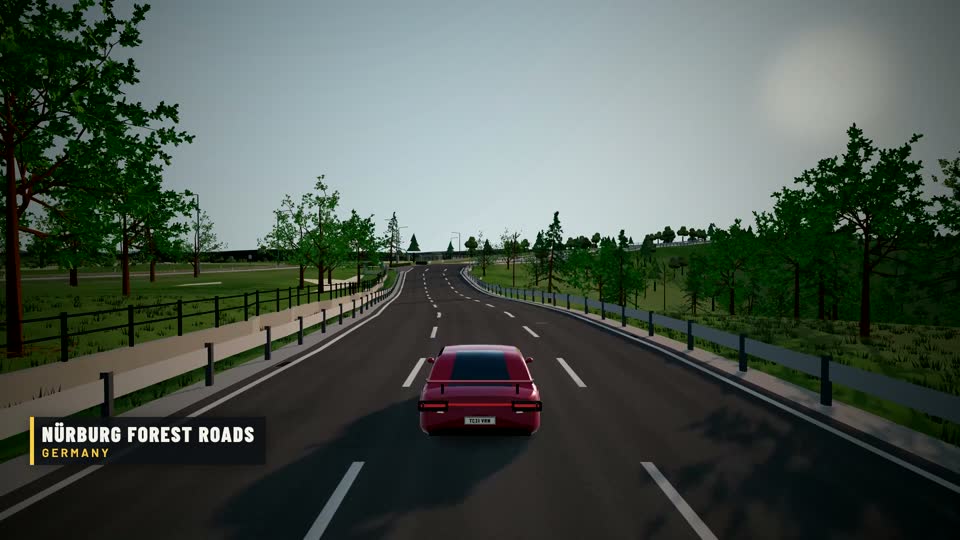
The Vesper GT is the game's sports coupe: rear-wheel drive, seven speeds and downforce. The Kaze RS is a rear-drive drift car tuned to slide; tap Space for the handbrake to start a drift and set Stability assists to Sport or Off so the car lets the tail move. In World Motorsport the Vesper GT races in GT & Endurance alongside the Regent and Anvil 440, and in Drift alongside the Kaze RS.
Good roads for a light rear-drive car: the hairpins of the Stelvio Pass, the Tail of the Dragon and the Hakone Turnpike, free in the browser.
Questions
Does a sports car have to have two seats?
No. Traditional sports cars were two-seat roadsters, but most definitions also accept a 2+2 with small rear seats. A car with roomy rear seats is usually called a sports saloon.
What is the best-selling sports car?
The Mazda MX-5, which Guinness World Records has certified as the best-selling two-seater sports car since 2000. The one-millionth was built in April 2016.
Is a Porsche 911 a sports car?
Yes. It is a 2+2 sports car and the best-known rear-engined one, using that layout continuously since 1963.
What is the difference between a sports car and a supercar?
A sports car puts handling and driving feel first and can be cheap and light. A supercar adds exotic performance, price and rarity.
Sources
Facts on this page come from these sources, checked on 20 November 2026. Details about the game come from the game itself.
- Sports car, Wikipedia
- Mazda Produces One Millionth Mazda MX-5, Mazda North American Operations
- Emphasis on sports cars: the Lotus-Austin (September 1951), Motor Sport Magazine archive
- Car layout, Wikipedia
- Mazda MX-5 production reaches 900,000 units, Mazda Newsroom
- Understeer vs oversteer, Continental Tyres
- Caterham 7, Wikipedia
- Lotus Elise, Wikipedia