
Supercar vs hypercar: what the words really mean
There is no official line between a supercar and a hypercar. A supercar is a road-legal car with race-car pace and exclusivity; hypercar is the informal label for the rarest, most powerful and most expensive of them, usually built in runs of a few hundred or fewer[1].
No rulebook, only usage
No body certifies a car as a supercar. The word describes a street-legal sports car with power, speed and handling close to a racing car's, plus a cachet that comes from pedigree or rarity, and it is most often used for low, mid-engined, expensive coupés[1]. One interpretation from the 1980s and 1990s asked for two seats, at least eight cylinders, at least 400 bhp and a top speed of 180 mph or more, but that was a rule of thumb, not a standard[1].
Hypercar stretches the idea upwards and is just as loose. In motoring journalism it usually means a limited-production car built in runs from two figures up to the low thousands, priced above the maker's normal range, often at more than a million euros, dollars or pounds[1]. Some makers, such as Bugatti, Pagani and Koenigsegg, build nothing else[1].
So the honest answer to supercar vs hypercar is a matter of degree: power, price, production numbers and technology. A car can also slide from one word to the other as newer cars move the bar.
Where the words came from
In Europe the Lamborghini Miura, shown in 1966, is often called the first supercar[1]. In the United States the word arrived earlier and meant something else: in the 1960s the fastest American muscle cars were called supercars, and Car Life wrote of a supercar club in May 1965[1]. The S/C in the 1969 AMC S/C Rambler is said to stand for SuperCar[1].
Which car was the first hypercar is still argued over. Candidates put forward include the 1954 Mercedes-Benz 300 SL, the Miura, the 1993 McLaren F1 and the 2005 Bugatti Veyron[1]. Bugatti's own heritage material calls the Veyron "the first hyper sports car of modern times"[2], which is a maker's claim rather than a ruling.
Five cars that set the bar
| Car | Year | Power | Source |
|---|---|---|---|
| McLaren F1 | 1992 to 1998 | 461 kW (618 hp; 627 PS) | Wikipedia[4] |
| Bugatti Veyron 16.4 | 2005 | 1,001 PS | Bugatti[2] |
| LaFerrari | 2013 | 963 PS (708 kW) combined | Wikipedia[5] |
| Bugatti Chiron | 2016 | 1,500 HP, as Bugatti's launch release puts it | Bugatti[3] |
| Rimac Nevera | 2022 (first delivery) | 1,408 kW / 1,914 hp | Rimac[6] |
McLaren F1. A 6.1-litre BMW V12, three seats with the driver in the middle, and, by Wikipedia's account, the first production car with a carbon-fibre monocoque. Gordon Murray led the engineering, Peter Stevens styled it, and 106 were built in all, 28 of them GTR racing cars. On 31 March 1998 a prototype averaged 240.1 mph (386.4 km/h) both ways for a production-car record[4].
Bugatti Veyron. An 8.0-litre W16, made by joining two VR8 engines at 90 degrees, with four turbochargers and 1,250 Nm of torque. Series production was confirmed in 2001, began in 2005, and the car topped 400 km/h[2].
Bugatti Chiron. 1,600 Nm, a road top speed limited to 420 km/h, and a run of 500 cars built at Molsheim[3].
The hybrid hypercars
In 2013 three cars turned the top of the market hybrid: the McLaren P1, the Porsche 918 Spyder and the LaFerrari[1]. The LaFerrari pairs a 6.3-litre V12 rated at 800 PS with a 163 PS electric motor in Ferrari's HY-KERS system, for 963 PS combined, and it was Ferrari's first full hybrid; 499 coupés were planned[5]. Later hybrids include the Mercedes-AMG One, the McLaren W1 and the Ferrari F80[1].
In these cars the electric motor mainly adds instant torque at low revs, filling the gaps in the petrol engine's delivery.
Electric hypercars
Battery-electric hypercars include the Pininfarina Battista, the NIO EP9, the Lotus Evija and the Rimac Nevera[1]. The Nevera is the reference point. Rimac quotes 1,408 kW (1,914 hp) from four motors, two of 226 kW at the front and two of 450 kW at the rear, 2,340 Nm, a 120 kWh battery, 0 to 100 km/h in 1.81 seconds and 412 km/h flat out[6].
It was unveiled as the C_Two at the 2018 Geneva show, the first production-spec car was delivered in August 2022, and only 71 were made before production ended, against plans for 150 Neveras and 40 Nevera Rs[7]. In May 2023 it set 23 performance records in a day, including 0 to 400 to 0 km/h in 29.93 seconds, then set the fastest production-EV times at the Goodwood hill climb (49.32 seconds, July 2023) and the Nürburgring (7:05.298, August 2023); in July 2025 the Nevera R added 24 more records, including 0 to 400 to 0 km/h in 25.79 seconds[7].
Electric power suits the hypercar formula because motors give full torque from rest and can be placed at each wheel, so the limits become tyres, cooling and battery weight rather than engine output.
How the bar keeps rising
Put the cited figures in order and the drift of the words becomes clear. The 1980s rule of thumb for a supercar was at least 400 bhp[1]. The McLaren F1 of the 1990s made 627 PS[4]. The Veyron passed 1,000 PS in 2005[2], the Chiron was announced with 1,500 in 2016[3], and the electric Nevera is rated at 1,914 hp[6]. Each step turned yesterday's hypercar into something closer to today's supercar.
Power is only part of it. Rarity moved too: the F1 ran to 106 cars[4], the Chiron to 500[3], and the Nevera to 71[7]. And the technology changed from a light, naturally aspirated V12, to a heavy quad-turbo W16, to hybrid V12s, to four electric motors. When people argue about whether a car is a supercar or a hypercar, they are usually arguing about where it sits on that moving scale.
Sports car, supercar or hypercar?
A rough guide that matches how the words are used:
- Sports car: built for handling and driving feel; can be cheap and light. See what is a sports car.
- Supercar: exotic performance and looks, usually mid-engined, sold as a regular model.
- Hypercar: a limited run at the very top of a maker's range, often with hybrid or electric power and a seven-figure price[1].
The word has also moved into racing. Since rule changes in 2021, hypercars have been the basis of the Le Mans Hypercar class in endurance racing[1]; types of race cars explains how that class works.
Drive an EV hypercar in Drive Your City
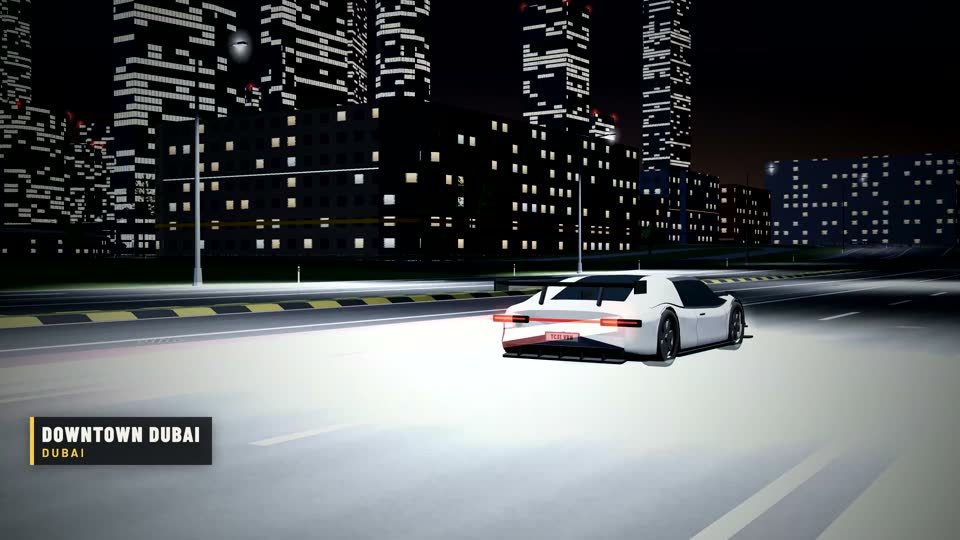
The game's top car is the Halcyon X, a fictional EV hypercar with four motors and 1,100 kW in the game's simulation (a game value, not a real car's). Hold Shift for nitrous, and set Stability assists to Sport or Off if you want it to slide before the electronics step in. For a car that feels closer to a front-engined supercar, the Vesper GT sports coupe is rear-wheel drive with seven speeds and downforce.
Both cars are entered in World Motorsport: the Halcyon X in Formula, Drag, Hill Climb and Special Events, the Vesper GT across most disciplines. Try the Halcyon X on the full Nürburgring Nordschleife lap or the Autobahn A9, all in the browser.
Questions
What is the difference between a supercar and a hypercar?
There is no official definition of either. Hypercar is used for the rarest, most powerful and most expensive supercars, usually built in small numbers and priced above the maker's normal range.
What was the first hypercar?
It is disputed. The Mercedes-Benz 300 SL, Lamborghini Miura, McLaren F1 and Bugatti Veyron are all put forward, and Bugatti calls the Veyron the first hyper sports car of modern times.
Is the McLaren F1 a supercar or a hypercar?
Both labels are used. It was built from 1992 to 1998 with 627 PS from a BMW V12 and is often named among the first hypercars.
What is the most powerful electric hypercar?
Among the cars here, the Rimac Nevera, which Rimac rates at 1,408 kW (1,914 hp) from four motors.
Sources
Facts on this page come from these sources, checked on 20 November 2026. Details about the game come from the game itself.
- Supercar, Wikipedia
- 15 years of Bugatti Veyron: how it all began, Bugatti Newsroom
- Geneva International Motor Show 2016 (Chiron world premiere), Bugatti Newsroom
- McLaren F1, Wikipedia
- LaFerrari, Wikipedia
- Nevera, Rimac Automobili
- Rimac Nevera, Wikipedia