
The racing line: entry, apex and exit
The racing line is the fastest path through a corner, not the shortest: the car uses the full width of the track, turning in from the outside, clipping the inside at the apex and running back out to the edge on exit[1][4].
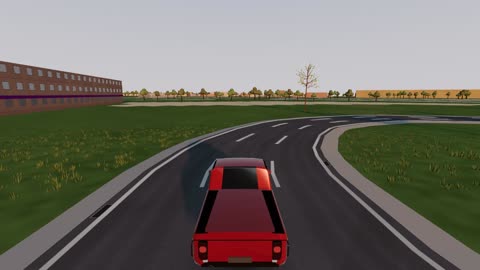
What the racing line is
A car can only corner as fast as its tyres allow, and a wider arc lets it carry more speed for the same grip. The racing line therefore uses every metre of track width: in from the outside edge, down to the inside, back out to the outside. Formula 1's own glossary describes it as the fastest way round a track, which is not always the shortest[4].
The best line is rarely a perfect circle. Its radius tightens while the car slows towards the apex, then opens out as the driver accelerates away[1]. Over a race weekend the line often shows up as a dark band of rubber on the track[1], and the small balls of shredded rubber, called marbles, collect just off it and cut grip for anyone who strays wide[5].
Braking point, turn-in, apex and track-out
Every corner on the line has four reference points.
- Braking point: the spot before the corner where the driver starts braking. Braking later can win a place but risks missing the corner[3].
- Turn-in: where the driver starts steering, from the outside edge.
- Apex: the point closest to the inside kerb, usually around the middle of the corner[3].
- Track-out: where the car reaches the outside edge again on exit, with the steering unwinding and the throttle open.
Drivers ride the kerbs when that is the faster line, but hitting them too hard can damage the car[5]. On a new track, the first job is to find fixed markers for each of these points so they can be repeated lap after lap.
Geometric apex versus late apex
The geometric line is the widest constant arc through a single corner, with the apex at its midpoint. It carries the most speed through the corner itself. A late apex means turning in later and reaching the inside further round. The entry is slower and tighter, but the exit is straighter, so the driver can open the throttle earlier and arrive at the next straight faster[1]. Because most lap time is spent on straights, that usually pays off.
An early apex does the opposite: faster in, but the car runs out of road on exit and the driver must lift. It is widely seen as a beginner's mistake[1]. Driving coach Ross Bentley's rule of thumb is that the faster the corner, the closer to the geometric line you should drive[1].
| Line | Turn-in | Entry speed | Exit speed | Best for |
|---|---|---|---|---|
| Early apex | Early | High | Low | Rarely the right choice |
| Geometric apex | Middle | Medium | Medium | Fast corners, corners leading to another corner |
| Late apex | Late | Lower | Highest | Slow corners onto long straights |
Compromise corners and sequences
When corners come close together, the exit of one is the entry to the next, and the driver cannot take the ideal line through both. The usual rule is to work backwards from the corner that leads onto the longest straight and sacrifice the line through the earlier ones to be in the right place for it[1].
Silverstone's Maggotts and Becketts show this well. They are a fast left-right-left-right sequence with lateral forces above 5g, followed by Chapel, which leads onto the Hangar Straight[6]. A driver who chases the perfect line through the first left ends up off line for the rest, and the speed onto the Hangar Straight is what counts. Esses, chicanes and double-apex corners all need the same thinking.
Trail braking, a track technique
Trail braking means keeping some brake pressure on past the turn-in point and easing it off gradually towards the apex[2]. Braking shifts weight onto the front tyres, which gives them more grip and helps the car turn in and rotate, reducing understeer[2]. It also keeps the tyres working near their limit instead of wasting grip in the gap between braking and steering[2].
It is hard to learn. A tyre's grip is shared between braking and cornering, so too much brake while turning can overload the front tyres or, in a car with brake bias near neutral, lock the rears and spin the car[2]. That is why beginner riding courses teach slowing before the turn, and why trail braking is treated mainly as a track skill[2], practised on a closed circuit with instruction.
Why there is no single perfect line
People who compute optimal lines try to maximise average speed while keeping curvature and distance low. For a corner with its apex in the middle, a common answer is an Euler spiral, a curve whose radius changes at a steady rate, but even that is only close to the best and can often be beaten[1]. Drivers find their line by feel, video and data rather than by geometry alone.
The type of corner changes the answer. Slow, tight corners onto a straight reward a late apex and some trail braking, which helps most in tight turns, while fast, sweeping corners need less of it[2] and suit a line close to the geometric one[1]. A decreasing-radius corner, which tightens as you go round, usually needs a later apex still, because its tightest part comes last. The car matters too: a car with a lot of downforce can carry speed through fast corners that a road car must brake for, so the two take different lines through the same bend.
Racing lines in a race
The textbook line is for a clear track. In a race, a car close behind another loses downforce in the turbulent air it leaves, so following through fast corners is hard[3]. Drivers defend by taking a tighter line into a slow corner so no one can dive up the inside, which costs them exit speed. The attacker may outbrake the car ahead, braking later to pass, at the risk of running wide or locking a wheel[5]. A good line is a starting point that drivers adapt lap by lap.
Practise the racing line in Drive Your City
Drive Your City is a free browser game on real roads, and its circuits are a safe place to try this. Open the Race menu for a Circuit or Time Trial race, or the World Motorsport tab for the Formula discipline, which is built around downforce and braking zones (races guide, World Motorsport). Venues include Silverstone, Monza and the Nürburgring Nordschleife.
Brake with S, steer with A and D, and press C for the hood or cockpit camera to judge turn-in points. With stability assists on Full, the car stays pointed where you steer. Sport and Off let it slide, so a late, clumsy brake shows up as a slide. A controller or touch controls on a phone work too.
Questions
What does outside-inside-outside mean?
It describes the racing line through a corner: turn in from the outside edge of the track, clip the inside at the apex, then let the car run back out to the outside edge on exit. Using the full width makes the arc as wide as possible, so the car can carry more speed.
Why do racing drivers use a late apex?
A late apex makes the corner exit straighter, so the driver can accelerate earlier and reach the following straight faster. It costs a little speed on entry, but more time is gained along the straight than is lost in the corner.
Should I use the racing line or trail braking on the road?
No. On public roads you stay in your lane, slow down before bends and keep to the speed limit. The racing line and trail braking are circuit techniques, best learned on a track day with an instructor.
Sources
Facts on this page come from these sources, checked on 20 November 2026. Details about the game come from the game itself.
- Racing line, Wikipedia
- Trail braking, Wikipedia
- F1 Glossary (A-E), Formula 1
- F1 Glossary (P-T), Formula 1
- F1 Glossary (K-O), Formula 1
- Silverstone Circuit, Wikipedia
- The Highway Code: general rules, techniques and advice for all drivers and riders (103 to 158), GOV.UK