
Motorway driving: joining, lane discipline, overtaking and breakdowns
On a UK motorway: match the speed of traffic on the slip road, keep to the left lane unless overtaking, pass only on the right, leave at least a two-second gap, obey red X lane closures, and if you break down, go left, get safe and get help[1][4].
Who can use a motorway
Motorways are for fast traffic only. In the UK, pedestrians, cyclists, horse riders, learner motorcyclists, motorcycles under 50 cc, some slow vehicles and mobility scooters may not use them. Learner car drivers may, but only with an approved driving instructor in a dual-control car showing L plates[1].
Traffic moves faster, so you have less time to react; the Highway Code asks you to check mirrors earlier and look further ahead than on other roads[1].
Joining
Use the slip road to build up to the speed of traffic in the left lane, and give priority to traffic already on the motorway. Look for a safe gap, merge into it, and stay in the left lane long enough to settle at the traffic's speed before you think about overtaking. Do not cross solid white lines, and if the slip road becomes an extra lane, stay in it[1].
Use your mirrors and a quick look over your shoulder as you run along the slip road, so you know where the gap is before you reach the end of it. Signalling early tells drivers in the left lane what you intend, and many will move over if they can.
Lane discipline and overtaking
In the UK, keep to the left lane unless you are overtaking, and move back when it is safe[1]. Overtake only on the right, after checking mirrors and blind spots and signalling, and never move to a lane on the left to pass[1]. The one exception is slow, congested traffic, where you may keep pace with your own lane even if it passes vehicles on the right; do not weave between lanes[1].
On motorways with three or more lanes, vehicles towing trailers, goods vehicles over 3.5 tonnes and passenger vehicles carrying more than eight passengers may not use the right-hand lane except in specific cases[1].
In keep-right countries
Where traffic drives on the right, the pattern is mirrored. On Germany's autobahns the Rechtsfahrgebot requires drivers to use the right lane when it is free, with the left lane generally for overtaking, and lorries and buses keep to the right[8]. Overtaking rules differ in detail between countries, so check before you drive abroad.
Speed and space
The national limit on UK motorways is 70 mph for cars and motorcycles, or 60 mph when towing a caravan or trailer[2]. A speed in a red circle on an overhead sign is mandatory, and the limit is a maximum, not a target[1].
Keep at least a two-second gap on fast roads, double it in the wet and leave far more on ice[3]. In good conditions, a steady speed within the limit and a constant gap make a motorway calm; in rain, ice or fog, increase it[1]. Monotony makes drivers drowsy, so plan breaks and use service areas[1].
Germany is the best-known exception on speed: where no limit is posted, the autobahn has an advisory speed of 130 km/h, and driving faster can leave a driver partly liable after a crash[8].
Signs, signals and smart motorways
Flashing amber lights warn of a hazard ahead: slow down and do not speed up again until you pass a signal that is not flashing or a sign showing the national limit or END[1]. A red X with flashing red lights means a lane is closed, and you must move out of it and not drive in it until a speed limit or END sign appears[1]. National Highways says ignoring a red X can bring a fixed penalty of up to £100 and three points[6].
About a quarter of England's motorway network is now smart motorway[5], where a hard shoulder may become a running lane. Use it as a lane only when a speed limit is shown above it; a red X or a blank sign means emergencies only[1].
Leaving the motorway
Watch for exit signs, move into the left lane in good time, signal left and slow down on the slip road, not on the main carriageway[1]. If you miss your exit, carry on to the next one: you must never reverse, cross the central reservation or drive against the traffic[1].
Junctions and stopping
Approaching a junction, read the signs early and get into the right lane in good time; only use a lane that leads off the motorway if you mean to leave[1]. Do not stop on the carriageway, hard shoulder, slip road, verge or in an emergency area except in a real emergency or when told to, and never stop to make or take a phone call[1]. Nobody should walk on a motorway except in an emergency[1].
Breakdowns: go left, get safe, get help
If your car develops a problem, try to leave at the next exit or service area. If you cannot, the Highway Code and National Highways give three steps[4][5]:
- Go left: move into the left lane and stop as far left as you can, ideally in an emergency area or on the hard shoulder, with hazard lights on.
- Get safe: if it is safe, leave by the door away from traffic and wait behind a barrier. Do not attempt repairs or place a warning triangle on a motorway.
- Get help: call National Highways or your breakdown provider from a safe place.
If you cannot reach the left or cannot get out safely, stay in the car with your seat belt on and hazards on, and call 999[4].
Emergency corridors in Germany
When traffic on a German motorway slows to walking pace or stops, drivers must form a Rettungsgasse, an emergency corridor, between the far-left lane and the lane next to it, so police and ambulances can get through. Failing to form one, or using it to jump the queue, costs 200 to 320 euros, a one-month driving ban and two points[7].
Fast roads in Drive Your City
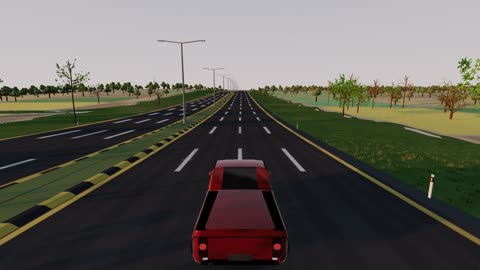
The game's fast roads are a place to practise judging gaps and merging with traffic at speed. The Autobahn A9 and the Mumbai-Pune Expressway are both drivable, with traffic including cars, buses and street racers.
Press M for the map, with search and turn-by-turn navigation, so you can plan an exit in advance rather than at the last moment, and O for autodrive to watch how the car keeps to its lane. The traffic and autodrive guide explains both. Police are optional in free roam.
Questions
What is the motorway speed limit in the UK?
70 mph for cars and motorcycles, or 60 mph when towing, unless signs show a lower limit.
Can learner drivers use motorways in the UK?
Yes, but only with an approved driving instructor in a car with dual controls and L plates; family and friends cannot supervise them there.
Can you overtake on the left on a UK motorway?
No, except in slow-moving congestion where your lane happens to move faster than the lane to your right.
What should I do if I break down on a smart motorway?
Go left into an emergency area or the left lane, put hazards on, get out on the side away from traffic if safe, and call for help; if you cannot, stay belted in and call 999.
Sources
Facts on this page come from these sources, checked on 20 November 2026. Details about the game come from the game itself.
- The Highway Code: motorways (253 to 273), Highway Code (GOV.UK)
- Speed limits, GOV.UK
- The Highway Code: general rules, techniques and advice for all drivers and riders (103 to 158), Highway Code (GOV.UK)
- The Highway Code: breakdowns and incidents (274 to 287), Highway Code (GOV.UK)
- Driving on motorways, National Highways
- Red X, National Highways
- Creating an emergency corridor will save lives, Federal Ministry of Transport (Germany)
- Autobahn, Wikipedia