
Driving mountain roads: the great passes and how to drive them
Drive mountain roads in a low gear on the way down so the engine does most of the braking, give way to traffic coming uphill where you can, and check the pass is open before you set off. The rest is knowing the roads: the Stelvio, the Transfăgărășan and the Col de Turini each have their own character and season.
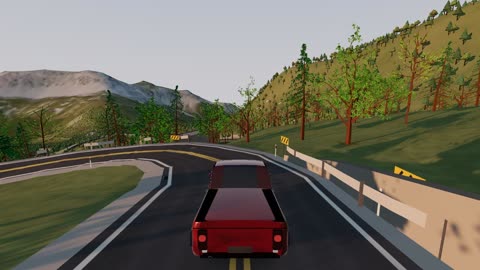
What makes mountain roads different
A mountain pass packs a lot into a short distance: steep gradients, tight hairpins, sheer drops, thin air and weather that changes by the hour. The Stelvio Pass shows how much a single road can vary. Its northern side runs for 28 km with 48 mostly tight hairpins, while the southern side towards Bormio covers 22 km with 34 more sweeping ones[1].
Mountain roads are also shared roads. Expect cyclists on the climbs, buses and lorries that need the whole width of a hairpin, and walkers at viewpoints. In Sequoia and Kings Canyon, the US park service warns that vehicles over the length limits cannot get round the tightest curves without crossing the centre line[6], which is worth remembering whenever you meet a coach on a bend.
Going down: let the engine do the braking
The biggest mistake on a long descent is riding the brakes. The US National Park Service advises shifting to a lower gear (2, 1 or L on an automatic) when going downhill, and warns that frequent braking can make brakes fail entirely and even catch fire[6]. The engine will sound louder as it holds the car back; that is normal.
The UK Highway Code makes the same point from the other side. Coasting, rolling with the clutch down or in neutral, removes engine braking, and speed downhill then builds quickly[7]. Choose the gear before the descent starts, brake firmly and briefly before each hairpin rather than lightly all the way down, and use the turnouts to let faster traffic by[6].
Going up
On the climb, the main job is choosing a gear that keeps the engine pulling through each hairpin without labouring. Look across the inside of a switchback before you commit, because what is coming down may be wider than you.
Who gives way on a narrow mountain road
Where two vehicles cannot pass, the rules depend on the country. In the UK, the Highway Code asks drivers on single-track roads to give way to traffic coming uphill whenever they can, and to reverse to a passing place if needed[7]. Elsewhere the rule ranges from law to custom[8]:
| Country | Who goes first |
|---|---|
| Switzerland | Uphill traffic, unless the uphill car is closer to a passing place. Lorries, coaches and vehicles with trailers have priority either way, and post and line buses do on postal roads signed with a post-horn. |
| Italy | Uphill traffic on narrow mountain roads, with the same passing-place exception. |
| France | Uphill traffic, unless signs say otherwise. |
| Austria | No automatic uphill rule; the driver who can give way more easily does so. |
| Germany | No general uphill rule in the StVO; the driver for whom the manoeuvre is easier gives way. |
The logic behind the uphill rule is practical: the car going down can usually stop and reverse more easily than the one climbing. If in doubt, the safest choice is to give way.
Great passes to know
Stelvio Pass, Italy
At 2,757 metres, the Stelvio is the highest paved pass in the Eastern Alps and the second highest in the Alps, seven metres below the Col de l'Iseran. The Austrian Empire built the original road in 1820 to 1825, and it is open from May to November[1]. It is also the highest finish used by any of cycling's Grand Tours, and on summer days the climb fills with riders[1].
Transfăgărășan, Romania
The Transfăgărășan crosses the Făgăraș mountains at 2,042 metres. Nicolae Ceaușescu ordered it after the 1968 Soviet-led invasion of Czechoslovakia; it was built from 1970 to 1974 and opened on 20 September 1974. The road has five tunnels, and the Bâlea Tunnel, 884 metres long, is the longest road tunnel in Romania; paving went on until 1980[2]. In 2009, Top Gear's Jeremy Clarkson called it the best road in the world[2].
Col de Turini, France
The Col de Turini in France reaches 1,607 metres and is famous for its hairpins. The Monte Carlo Rally runs a 31 km stage over it between La Bollène-Vésubie and Sospel; when crews used to climb it at night, fans called it the "night of the long knives"[3]. The gradients show why it suits a rally: from Lantosque the western side climbs 15.3 km at an average of 7.2 per cent, with a steepest section of 9 per cent, while the longer climb from Sospel averages 5.2 per cent over 24.1 km[3].
Serra do Rio do Rastro, Brazil
The SC-390 climbs the Serra Geral escarpment in Santa Catarina through 284 curves in about 24 km, rising from roughly 200 to 1,460 metres. It was paved in concrete between 1984 and 1986, the first concrete-paved highway in Santa Catarina, and the speed limit on the serra is 40 km/h[4]. Lauro Müller sits at the foot and Bom Jardim da Serra at the top, so many drivers go up one way and come back the same road[4].
Tail of the Dragon, USA
US 129 at Deals Gap, on the North Carolina and Tennessee line, is said to have 318 curves in 11 miles. Its speed limit was cut to 30 mph in 2005, and about 37 people died on the stretch between 2000 and 2017[5], a reminder that a famous road is not a race track.
Weather and the season
High passes close for snow, and opening dates move with the weather. The Transfăgărășan is usually closed from late October until late June[2], and the Stelvio opens from May to November[1]. In Sequoia and Kings Canyon, winter conditions can arrive at higher elevations any time from November to June, and chains may be required[6]. Check the road authority's status page on the day, not last week's forum post.
Fog is the other mountain hazard. On the Serra do Rio do Rastro, fog can close in within minutes; the state highway police advise slowing down, leaving more space and using dipped beams or fog lights rather than full beam[4]. In winter the same road can ice over, and crews spread salt to keep it open[4].
Even in summer, set off early. Popular passes fill with cyclists, coaches and camper vans by late morning, afternoon storms are common in the mountains, and a pass driven in the cool, quiet first hours of the day is safer and far more enjoyable.
Drive the passes in Drive Your City
Several of these roads are rebuilt from open map and elevation data, so the climbs and hairpins follow the real ground. Drive the Stelvio Pass, Col de Turini, Serra do Rio do Rastro, Sa Calobra, Snake Pass, Jebel Jais, Espinazo del Diablo and the Tail of the Dragon in free roam.
For a timed run, the Race menu's Tracks tab has hill tracks on the Stelvio, Col de Turini, Sa Calobra, Snake Pass, Jebel Jais and Serra do Rio do Rastro, with Sprint, Time Trial, Checkpoint, Drift and Speed Trap races (see races). In World Motorsport, Col de Turini is a night rally stage, Snake Pass is a rally stage, and the Stelvio and Jebel Jais are hill climbs: one run to the summit, ranked against the field. Press B for fog or rain to see how much harder a pass gets (weather and time of day); there is no snow or ice in the game.
Questions
Should you use the brakes or a low gear going down a mountain?
Use a low gear so the engine does most of the work, and brake firmly before bends rather than all the way down. Constant braking on a long descent can overheat the brakes until they fade or fail.
Who has right of way on a narrow mountain road?
In Switzerland, Italy and France the vehicle going uphill generally has priority, with exceptions near passing places and, in Switzerland, for heavy vehicles and postbuses. Austria and Germany have no automatic uphill rule, and the UK Highway Code asks drivers to give way to uphill traffic where they can.
What is the highest paved pass in the Alps?
The Col de l'Iseran in France at 2,764 metres. The Stelvio Pass is second at 2,757 metres and is the highest in the Eastern Alps.
When is the Transfăgărășan open?
It is usually closed from late October until late June because of snow, though dates vary with the weather each year.
Sources
Facts on this page come from these sources, checked on 20 November 2026. Details about the game come from the game itself.
- Stelvio Pass, Wikipedia
- Transfăgărășan, Wikipedia
- Col de Turini, Wikipedia
- Serra do Rio do Rastro: a história, a engenharia e o roteiro da estrada mais sinuosa do Brasil, AutoPapo
- Deals Gap, North Carolina, Wikipedia
- Driving Mountain Roads: Sequoia & Kings Canyon National Parks, US National Park Service
- The Highway Code: general rules, techniques and advice for all drivers and riders (103 to 158), Highway Code (GOV.UK)
- Wer hat Vorfahrt am Berg? Diese Regeln der Ski-Länder sollten Autofahrer kennen, auto motor und sport