
Weight transfer: how braking, accelerating and cornering move load
Weight transfer is the shift of load between a car's tyres when it brakes, accelerates or turns: braking pushes load onto the front tyres, accelerating onto the rears, and cornering onto the outside pair. The car weighs the same throughout, but how that weight is shared, and so how much grip each tyre has, keeps changing[2].
What weight transfer means
A car sits on four small tyre contact patches. When the car is parked on level ground, each tyre carries a fixed share of the weight. The moment you brake, accelerate or steer, that share changes. The total does not change; the distribution does[2].
Driving coaches describe three movements[2]:
- Dive: under braking the nose drops and load moves onto the front tyres.
- Squat: under acceleration the tail drops and load moves onto the rear tyres.
- Roll: in a corner the body leans out and load moves onto the outside tyres.
Engineers are stricter with words. They call the change in load on each wheel load transfer, which happens even in a perfectly rigid car with no suspension, and keep weight transfer for the small extra effect of the body's centre of mass actually moving. The car industry usually calls both "weight transfer", which is how this article uses it[1].
Why load changes grip
A tyre grips harder when more load presses it into the road, but the gain is not proportional. Engineers call this tyre load sensitivity, and its consequence is simple: whenever load moves from one tyre to another, the pair as a whole loses some grip[1].
Driver61 uses round numbers to show it. Give each tyre 25 units of grip on a level car, 100 in total. Under braking the fronts might rise to 30 each while the rears fall to 15 each, a total of 90. The car now has more grip at the front than before and much less at the rear, and less overall[2]. That is why smooth drivers try to keep the car's platform as level as they can.
There is a second limit on top. A tyre's grip is shared between slowing or driving the car and turning it. Engineers draw this as a circle of forces: any mix of braking and cornering force is possible as long as it stays inside the circle, so the more grip you spend on braking, the less is left for steering[3].
The numbers: a worked example
The size of a longitudinal transfer follows a short formula: the change in load on the front axle equals the car's mass times its deceleration times the height of its centre of mass, divided by the wheelbase[1]. A lower centre of mass or a longer wheelbase means less transfer[1].
Take an illustrative 1,500 kg car with 60 % of its weight on the front axle, a centre of mass 0.5 m above the road and a 2.7 m wheelbase. Braking at 0.8 g moves 0.8 × 0.5 ÷ 2.7, about 15 % of the car's weight, onto the front axle. Accelerating at 0.3 g moves about 6 % the other way. The figures below come from that formula, not from a test of any real model.
| Situation | Front axle | Rear axle |
|---|---|---|
| Parked, level | 900 kg (60 %) | 600 kg (40 %) |
| Braking at 0.8 g | about 1,120 kg (75 %) | about 380 kg (25 %) |
| Accelerating at 0.3 g | about 815 kg (54 %) | about 685 kg (46 %) |
Sideways transfer works the same way with the track width in place of the wheelbase. Wikipedia's example is a car cornering at 0.9 g with a 550 mm centre of mass and a 1,650 mm track: 30 % of its weight moves across, the outside tyres carry 60 % more than at rest, the inside tyres 60 % less, and total grip falls by about 6 %[1]. A wider track reduces the effect[1].
Body roll itself adds surprisingly little. In the same example, the centre of mass moving up to 30 mm sideways adds under 2 % of extra transfer[1]. Most of the effect comes from the car's height and its acceleration, not from how much it leans.
Braking: dive and the front tyres
Braking moves load forward, so the front tyres gain grip and the rears lose it[2][4]. Two things follow. The front tyres are doing most of the stopping, and the rear of the car is at its lightest just as you arrive at a bend.
This is why the familiar advice is to do most of your braking in a straight line, before you turn. The Highway Code puts the road version plainly: brake early and lightly, build the pressure as you slow, then ease off just before you stop[6]. A gentle start lets the load move onto the front tyres before you ask them for full effort, and easing off at the end stops the car pitching back.
Too much front braking has a cost too. If braking uses up the front tyres' grip, there is none left to turn, and the car carries straight on: understeer[4].
Accelerating: squat and the driven wheels
Acceleration moves load rearward[4]. A car that drives its rear wheels gets extra load on the tyres doing the work, while a car that drives its front wheels loses some from them. The front tyres also have less load to steer with, which is one reason a car can run wide when you accelerate hard out of a bend[8].
Cornering: roll and the outside tyres
In a corner the outside tyres carry most of the load and do most of the work, while the inside pair contributes little[2]. That balance can be upset by any sudden change. Lifting off the accelerator mid-corner moves load forward and lightens the rear, and on a car near its limit that can let the rear slide. Racing coaches call it lift-off oversteer[7].
The same physics explains why surprises in a bend are dangerous on the road. A sudden lift, stab of the brake or extra flick of steering moves load quickly onto one corner of the car while taking it from another.
Smooth inputs keep the car balanced
Sharp inputs throw load suddenly onto one end or one side, and that spike is when a tyre is most likely to lose traction. Smooth, progressive inputs keep transfer gentle and leave grip for braking, turning and accelerating[2]. The Highway Code makes the same point from the other end: skids are usually caused by harsh braking, accelerating or steering, or by speed too high for the conditions[6].
Racing drivers use transfer on purpose. Trail braking, for example, keeps a little brake on into the turn so the loaded front tyres bite and the car rotates, then releases it before the apex[5]. That is a track technique, taught with coaching on a closed circuit; on the road the aim is the opposite, a calm car with grip in reserve.
Feel it in Drive Your City
Drive Your City is a safe place to notice how inputs change a car's behaviour. Take the Pico city hatchback (front-wheel drive, 980 kg) and the Kaze RS drift car (rear-wheel drive) to the same quiet corner and compare them: brake fully in a straight line, then try braking while already turning, then try lifting off mid-bend.
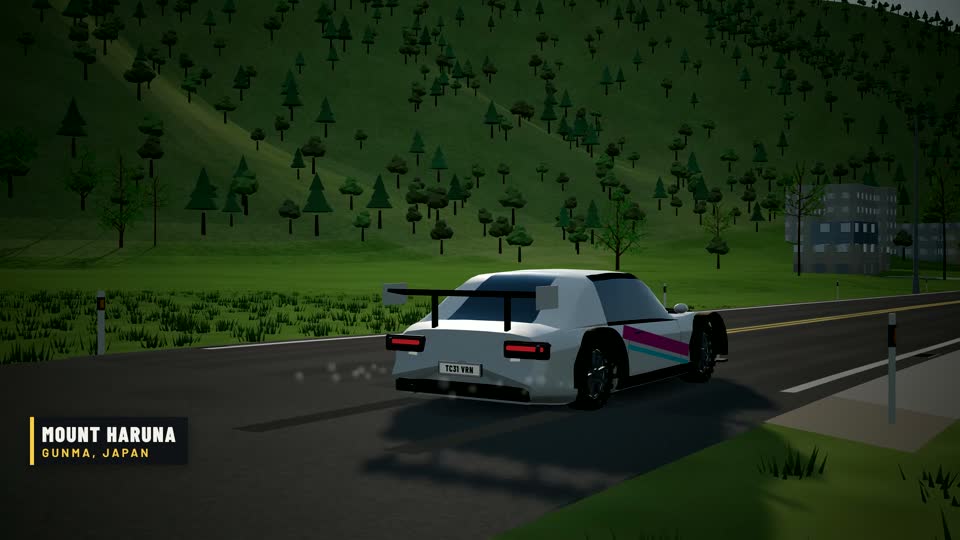
Open the game settings and change Stability assists. On Full, traction and stability control keep the car pointing where you steer; on Sport, the car allows more wheelspin and slide first; on Off, it is all yours, though ABS stays on. The Bastion SUV with full-time all-wheel drive makes a third comparison. Press C for the hood or cockpit camera if you want a driver's-eye view, and Space for the handbrake. Mount Haruna has plenty of linked bends to practise on.
Questions
Does a car get heavier when it brakes?
No. Its total weight stays the same; braking only shifts more of that weight onto the front tyres and less onto the rears.
Does lowering a car reduce weight transfer?
Yes. Transfer depends on the height of the centre of mass, so a lower car moves less load for the same braking or cornering force, as does a longer wheelbase or wider track.
Is weight transfer the same as weight distribution?
No. Weight distribution is how load is shared when the car is at rest; weight transfer is how that share changes when the car brakes, accelerates or turns.
Sources
Facts on this page come from these sources, checked on 20 November 2026. Details about the game come from the game itself.
- Weight transfer, Wikipedia
- What is weight transfer?, Driver61
- Circle of forces, Wikipedia
- Understeer and oversteer, Wikipedia
- How to trail brake: what trail braking is and why it's fast, Driver61
- The Highway Code: general rules, techniques and advice for all drivers and riders (103 to 158), Highway Code (GOV.UK)
- What is oversteer?, Driver61
- What is understeer and how can it be corrected?, Driver61